
Originally published: December 2025 | Updated: August 2026
Reviewed by Dr. Michael Berglass
Bone Grafting for Dental Implants in Boynton Beach: Who Needs It and Why?
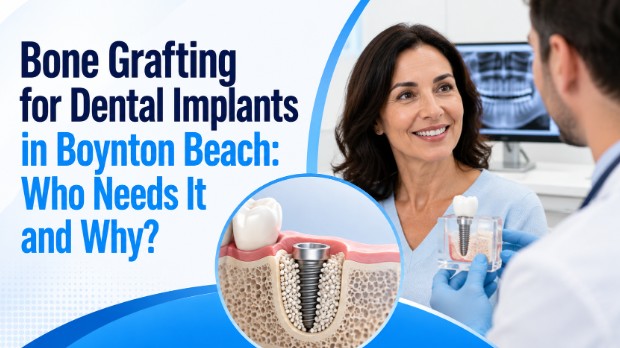
Bone grafting rebuilds a jawbone that’s too thin, soft, or shrunken to securely anchor a dental implant.
Boynton Implant and Cosmetic Dentistry performs this procedure in-office when a CBCT scan shows insufficient bone density at the implant site, before implant placement can proceed.
Healing time varies by patient and graft size, though three to six months is the commonly cited range before an implant can be placed safely.
Boynton Beach patients wondering whether they need a bone graft before implants can request a free consultation and 3D scan to find out.
Patients need bone grafting when a CBCT scan shows the jawbone is too thin, soft, or shrunken to anchor an implant securely — most often after long-term tooth loss, gum disease, or years of denture wear.
A CBCT scan determines whether a specific patient needs grafting; the situations below are commonly associated with bone loss, but none of them predict an individual outcome without imaging:
| Situation | How It May Affect Bone | Why |
| Tooth lost less than 6 months ago | Often less bone loss has occurred | Bone hasn’t had much time to shrink |
| Tooth missing for 1+ years | Bone loss becomes more likely over time | Extended time without chewing pressure can lead to resorption |
| Previous gum disease | Bone loss is a common complication | Infection can affect the bone that supports teeth |
| Long-term denture wearer | Bone loss is common with extended use | Dentures rest on the gums and don’t stimulate the bone beneath |
| Tooth lost due to trauma | Bone impact varies by injury | Depends on the severity and location of the injury |
| Upper back teeth replacement | May require evaluation of sinus proximity | The sinus cavity sits close to the bone in this area |
Bone requirements vary by location in the jaw — back teeth, especially in the upper jaw, are more often affected by grafting decisions because the sinus cavity limits available bone there.
Tooth position alone doesn’t determine whether grafting is needed; a CBCT scan does.
If you’re ready to get started, call us now!
A dental bone graft places natural or synthetic bone material into a weakened area of the jaw, giving the body a framework to rebuild around.
Over the following months, the patient’s own bone cells grow into the graft material and gradually replace it — a fusion process the American Association of Oral and Maxillofacial Surgeons describes in its healing process guidance as occurring over several months following surgery.
Once the graft has matured into solid bone, the implant post can be placed into a stable foundation rather than compromised bone that might not hold it securely.
The graft procedure itself is performed under local anesthesia, with light sedation available for anxious patients, and usually takes between 20 and 90 minutes, depending on the amount of bone the case requires.
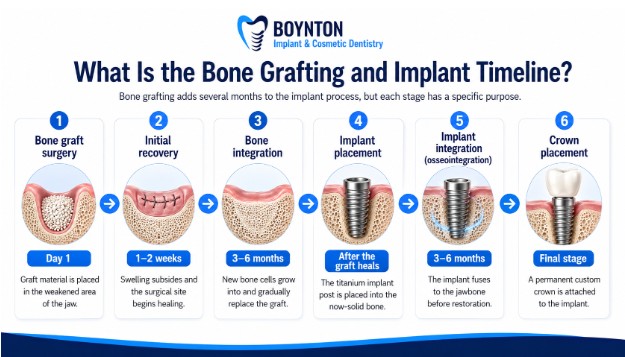
Bone grafting adds several months to the overall implant timeline, but the sequence is predictable, and each phase has a defined purpose.
| Phase | Timeframe | What Happens |
| Bone graft surgery | Day 1 | Graft material is placed in the weakened area of the jaw |
| Initial recovery | 1–2 weeks | Swelling subsides, and the surgical site begins healing |
| Bone integration | 3–6 months | New bone cells grow into and gradually replace the graft |
| Implant placement | After the graft heals | The titanium implant post is placed into the now-solid bone |
| Implant integration (osseointegration) | 3–6 months | The implant fuses to the jawbone before restoration |
| Crown placement | Final stage | A permanent custom crown is attached to the implant |
The exact healing time for any individual case depends on graft size, material, and the patient’s own healing response — the timeline above reflects typical ranges, not a fixed schedule.
A retrospective study of 158,824 implants — including 45,715 placed with bone grafting — published in the Journal of Functional Biomaterials (Findler et al., 2026), found a 97.83% clinical success rate for the grafted group, statistically comparable to implants placed without grafting.
This reflects outcomes across a large patient population studied retrospectively, not a guaranteed result for any individual case. The same study found most failures occurred within the first year after placement.
If you’re ready to get started, call us now!
Bone grafting recovery commonly resembles that of a tooth extraction rather than a more invasive surgery, though individual experience varies.
Bone graft pricing depends on how much bone is needed, the type of graft material used, and whether the graft is combined with implant surgery in the same visit.
Simple socket grafts typically run a few hundred dollars, while larger ridge augmentation or sinus lift procedures cost more due to the additional material and surgical time involved.
The practice provides an exact quote after a 3D scan confirms how much grafting a case requires — patients can review the implant cost breakdown to see how grafting fits into the overall treatment cost.
Dental insurance coverage for implants and grafting varies significantly by plan — some plans exclude it entirely, while others may partially cover the bone graft portion when it’s classified as medically necessary.
Dr. Berglass completed a one-year dental implant fellowship at North Shore-Long Island Jewish Hospital, now part of Northwell Health, in addition to 25 years of surgical experience.
Every bone grafting evaluation starts with a comprehensive exam and CBCT imaging rather than a visual assessment alone.
Two patients missing the same tooth may require different treatment plans — bone density, gum health, and jaw anatomy vary from person to person, which is why grafting decisions follow CBCT findings rather than general assumptions about age or tooth location.
When adequate bone is already present, the practice does not recommend grafting as an added step.
Key criteria reviewed during that evaluation include:
Patients with sufficient bone density may qualify for implant placement without grafting; when bone is insufficient, Dr. Berglass develops a treatment plan that includes grafting as the first step. Patients can review full provider credentials before scheduling a consultation.
Do all dental implant patients need a bone graft first? Not every implant patient needs a bone graft — grafting becomes necessary when the jawbone is too thin, soft, or shrunken after tooth loss. A CBCT scan measures bone quantity and quality to determine whether an implant can be placed safely.
How long after a bone graft can I get my dental implant? Most patients need three to six months of healing before an implant can be placed in a grafted area. Small socket grafts often heal faster, while larger ridge or sinus grafts take longer. Imaging confirms the graft has matured enough for stable implant placement.
Is bone grafting safe for older adults or people with medical conditions? Bone grafting can be safe for many older adults and patients with medical conditions when properly planned. The practice reviews medications, blood thinners, diabetes, and smoking status beforehand and coordinates with a patient’s physician when needed. Any changes to a patient’s medications are directed by their own physician.
Will I be without a visible tooth while the bone graft heals? Patients aren’t always without a visible tooth during graft healing. A temporary flipper, Essix retainer, or removable partial denture may be an option to fill the gap during this period, depending on the case. The permanent implant crown is placed only after both the graft and implant have fully healed.
Does dental insurance help cover bone grafting? Coverage varies significantly by plan. Some plans exclude bone grafting and implants entirely, while others may partially cover the grafting portion when it’s deemed medically necessary. The practice can provide a pre-treatment estimate to help identify applicable coverage.
Can bone grafting and implant placement happen in the same visit? Sometimes. Cases with adequate residual bone may allow simultaneous grafting and implant placement in the same procedure, while cases needing more extensive rebuilding typically require full healing time before the implant can be placed. A CBCT evaluation determines which approach is best for a specific patient’s case.
What happens if I have too much bone loss for a standard graft? Patients with significant bone loss may still qualify for implants through advanced grafting techniques or full-arch solutions such as All-on-4, which use the denser remaining bone and can sometimes reduce the amount of grafting needed. A 3D scan shows what’s realistic for a specific case.
Does the bone grafting procedure itself hurt? The area is fully numbed before the procedure, so patients typically feel pressure rather than pain during grafting. Light sedation is available for anxious patients. Discomfort after the anesthesia wears off is usually manageable with standard pain medication and ice packs.
Boynton Beach patients unsure whether they need a bone graft can get a clear answer from a 3D scan — schedule a consultation with Dr. Berglass to find out what your case actually requires.
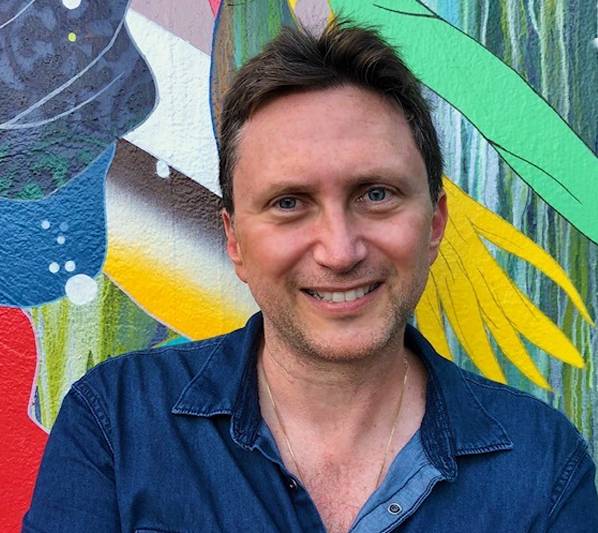
About Dr. Berglass
Dr. Michael Berglass, a dedicated dentist with over 25 years of experience, specializes in dental implants, cosmetic, and general dentistry in Boynton Beach, Florida. A proud alumnus of Stony Brook School of Dental Medicine (DDS, 1996), Dr. Berglass further honed his expertise with residencies in general practice and dental implants at North Shore-Long Island Jewish Hospital. His journey in dentistry has taken him from New York to North Carolina, and now to Florida, where he continues to offer top-notch dental care. Known for his wit and intellect, Dr. Berglass makes every patient's visit comfortable. A member of the American Dental Association and Florida Dentists' Association, he stays at the forefront of dental advancements. Dr. Berglass is committed to providing exceptional care and looks forward to welcoming you to his practice.
Reason To Smile

Phone
Address
2415 Quantum Blvd
Boynton Beach, FL 3342
Office Hours
Mon - Thurs: 8:30AM-5PM
Fri: 8:30AM-1PM
Sat - Sun: Closed


