
Originally published: October 2022 | Updated: August 2026
Reviewed by Dr. Michael Berglass
What Is the Bar Attachment Denture Dental Implant Technique?
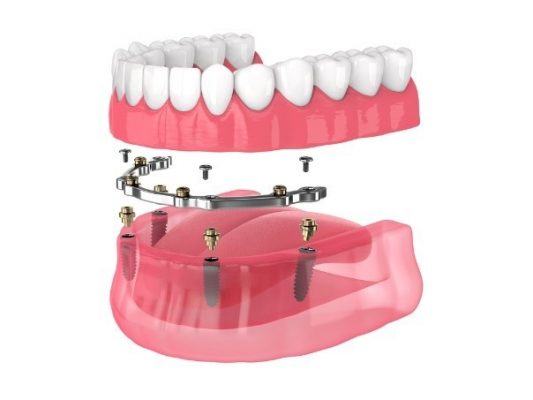
A bar attachment denture is an implant-supported overdenture that clips onto a metal bar anchored to two to four dental implants, replacing a full arch of missing teeth with lasting stability.
Dr. Michael Berglass, DDS, of Boynton Implant and Cosmetic Dentistry places the implants, fits the bar, and attaches the denture once the jawbone has healed.
The result is a denture that clips securely in place and preserves jawbone density better than removable dentures, offering a long-term option built on dental implants.
Traditional dentures that slip and shift can make eating and speaking difficult — Dr. Berglass offers bar-attachment consultations at the practice.
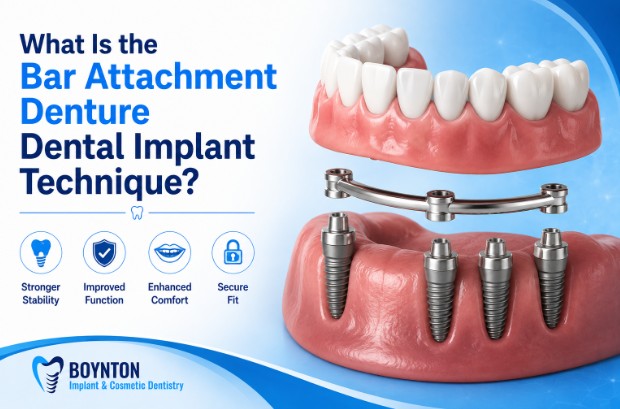
The American Dental Association describes an overdenture as a removable prosthesis that fits over remaining teeth or dental implants rather than resting directly on the gums.
The bar attachment version adds a milled metal bar between the implants, and the denture clips onto that bar instead of resting loosely on the jawbone.
Tooth loss leading to this treatment commonly results from advanced decay, gum disease, or trauma, and patients missing most or all of their replacement teeth in an arch are typical candidates.
Two to four implants usually anchor the bar in the lower jaw, while the upper jaw sometimes needs additional implants for stability.
Dr. Berglass places two to four implants in the jawbone during the dental implant procedure, then allows months for the bone to heal and fuse around them. This healing period, called osseointegration, determines how securely the finished bar and denture will hold.
Once healing is complete, the dentist attaches a custom-milled bar to the implants and fits the denture so it clips securely onto the bar.
Patients leave with a denture that stays in place during eating and speaking, unlike a conventional denture held only by suction or adhesive — a change many patients describe as restoring confidence in their smile.
If you’re ready to get started, call us now!
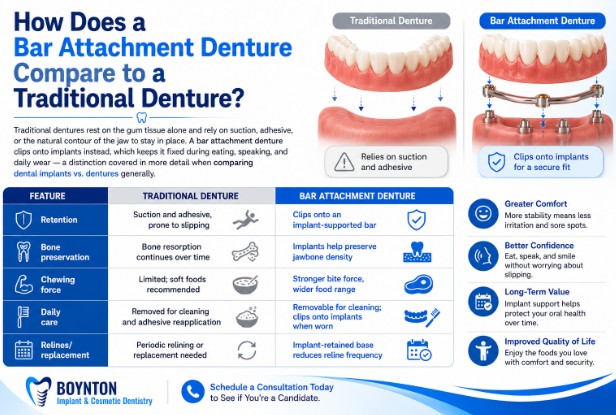
Traditional dentures rest on the gum tissue alone and rely on suction, adhesive, or the natural contour of the jaw to stay in place. A bar attachment denture clips onto implants instead, which keeps it fixed during eating, speaking, and daily wear — a distinction covered in more detail when comparing dental implants vs. dentures generally.
| Feature | Traditional Denture | Bar Attachment Denture |
| Retention | Suction and adhesive, prone to slipping | Clips onto an implant-supported bar |
| Bone preservation | Bone resorption continues over time | Implants help preserve jawbone density |
| Chewing force | Limited; soft foods recommended | Stronger bite force, wider food range |
| Daily care | Removed for cleaning and adhesive reapplication | Removable for cleaning; clips onto implants when worn |
| Relines/replacement | Periodic relining or replacement needed | Implant-retained base reduces reline frequency |
Cost is often the deciding factor between the two options, and implant pricing varies based on the number of implants placed and whether bone grafting is needed beforehand.
Slipping dentures limit which foods feel safe to eat — Dr. Berglass fits bar attachment dentures that clip securely in place; schedule a consultation at the practice.
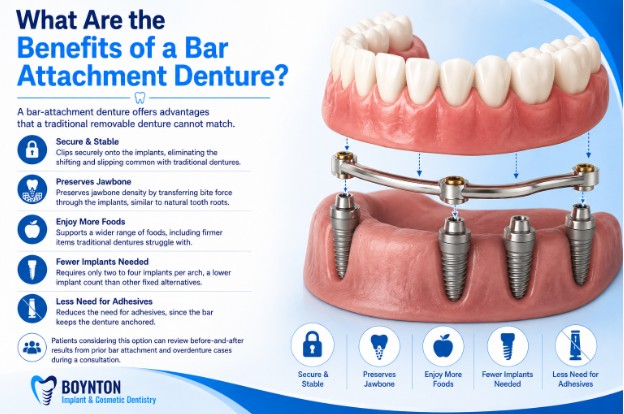
A bar-attachment denture offers advantages that a traditional removable denture cannot match.
Patients considering this option can review before-and-after results from prior bar attachment and overdenture cases during a consultation.
If you’re ready to get started, call us now!
Bone health and daily chewing function both factor into whether a bar attachment denture fits a patient’s needs.
Traditional dentures rest on the gum and bone without stimulating it, and unused bone gradually breaks down. Implants in a bar attachment denture transmit bite force into the jawbone the way natural tooth roots do, which helps slow that bone loss.
Patients with bar attachment dentures generally report stronger, more consistent bite force than patients wearing traditional dentures, since the denture no longer shifts during chewing.
A crossover clinical trial comparing ball and bar attachments found both systems produced good results, though maintenance needs differed between the two designs.
Overdentures can rest on remaining natural teeth or on dental implants, and implant-retained versions typically use one of two attachment styles: a connecting bar or individual ball-shaped attachments, sometimes called snap-in dentures.
| Measure | Bar-Retained Attachment | Ball/Solitary Attachment |
| 5-year implant survival | 96.3% | 89.5% |
| Peri-implantitis incidence | 5.1% | 25.8% |
| Marginal bone level change (5 yr) | -0.99 mm | -1.41 mm |
| Maintenance | Fewer routine adjustments in some studies | Individual attachments may need more frequent replacement |
A five-year randomized controlled trial comparing the two systems found higher implant survival and fewer complications with bar attachments.
A separate retrospective study spanning up to 20 years followed patients with bar-retained implant overdentures and found favorable long-term implant survival, supporting the bar attachment as a durable option for eligible patients.
Patients exploring comprehensive implant solutions can compare bar-retained options against other implant-supported designs during an exam.
Slipping, unstable dentures don’t have to be permanent — Dr. Berglass and the team at the practice fit bar attachment dentures built for lasting stability; call now to schedule a consultation in Boynton Beach.
What is a bar attachment denture?
A metal bar connects two to four dental implants, and the denture clips onto that bar rather than resting loosely on the gums. The denture stays fixed in place during eating and speaking, unlike a traditional denture that relies on suction or adhesive alone.
How many dental implants does a bar attachment denture need?
Most bar attachment dentures use two to four dental implants per arch, depending on jawbone density and the number of teeth being replaced. The implants anchor a milled metal bar, and the denture clips onto that bar for day-to-day stability and retention.
How long does bar attachment denture treatment take?
Bar attachment denture treatment typically spans months, since the jawbone needs time to heal and fuse with the implants before the bar and denture are attached. The exact timeline depends on bone density, healing response, and whether extractions precede implant placement.
Is a bar attachment denture removable?
Yes, a bar attachment denture can be removed for cleaning, though it clips securely onto the implant-supported bar during normal wear. Patients typically take it out at night and to clean both the denture and the bar, similar to caring for natural teeth.
How does a bar attachment denture compare to a traditional denture?
A bar attachment denture clips onto dental implants and stays fixed during eating and speaking, while a traditional denture rests on the gums and relies on suction or adhesive. The implant-supported version also helps preserve jawbone density that a traditional denture cannot maintain.
How does a bar attachment denture compare to a ball-attachment overdenture?
Both systems anchor a denture to dental implants, but a bar attachment connects the implants with a single milled bar while ball attachments retain the denture individually at each implant. Research comparing the two systems reports higher implant survival with bar attachments in longer-term studies.
Can a bar attachment denture help preserve jawbone density?
Yes, the dental implants supporting a bar attachment denture transmit bite force into the jawbone the way natural tooth roots do. This ongoing stimulation helps slow the bone loss that typically continues under a traditional denture resting on the gums alone.
How is a bar attachment denture cleaned?
Patients remove the denture daily to clean it with a denture brush and non-abrasive cleanser, then brush the bar and implant abutments with a soft toothbrush before reinserting the denture. Regular dental checkups confirm the bar and implants remain in good condition.
Who is a good candidate for a bar attachment denture?
Patients missing most or all of their teeth in an arch, with enough jawbone to support two to four implants, are typically good candidates. A dental exam and imaging confirm bone density and implant placement before treatment begins, ensuring the bar and denture fit correctly.

About Dr. Berglass
Dr. Michael Berglass, a dedicated dentist with over 25 years of experience, specializes in dental implants, cosmetic, and general dentistry in Boynton Beach, Florida. A proud alumnus of Stony Brook School of Dental Medicine (DDS, 1996), Dr. Berglass further honed his expertise with residencies in general practice and dental implants at North Shore-Long Island Jewish Hospital. His journey in dentistry has taken him from New York to North Carolina, and now to Florida, where he continues to offer top-notch dental care. Known for his wit and intellect, Dr. Berglass makes every patient's visit comfortable. A member of the American Dental Association and Florida Dentists' Association, he stays at the forefront of dental advancements. Dr. Berglass is committed to providing exceptional care and looks forward to welcoming you to his practice.
Reason To Smile

Phone
Address
2415 Quantum Blvd
Boynton Beach, FL 3342
Office Hours
Mon - Thurs: 8:30AM-5PM
Fri: 8:30AM-1PM
Sat - Sun: Closed


