
Originally published: July 2026 | Reviewed by Dr. Michael Berglass
Tooth Replacement Options After Extraction: Dental Implants vs. Bridges vs. Dentures
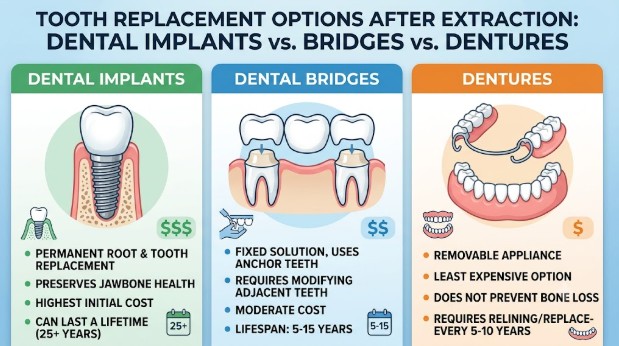
Tooth replacement after extraction is a decision between three options: a dental implant that fuses with the jawbone, a fixed dental bridge anchored to adjacent teeth, or a removable partial denture that clips onto surrounding teeth.
Dr. Michael Berglass, DDS, at Boynton Implant and Cosmetic Dentistry in Boynton Beach, Florida, evaluates patients for all three replacement pathways using CBCT imaging, so each patient receives a plan matched to their bone health, budget, and timeline.
Dr. Berglass at Boynton Implant and Cosmetic Dentistry offers free implant consultations for tooth replacement patients. Call 561-736-1700 or book online.
Four paths exist after losing a tooth: a dental implant, a fixed dental bridge, a removable partial denture, or no replacement. Each option differs in how it attaches, how long it lasts, whether it preserves bone, and what it costs upfront versus over a 20-year period.
A dental implant is a titanium post that an oral surgeon or implant dentist threads into the jawbone at the extraction site. The post fuses with the bone through a process called osseointegration over 3 to 6 months. Once integrated, a custom porcelain crown attaches to the post, restoring the full visible portion of the tooth and its root structure.
A fixed dental bridge is a prosthetic tooth (pontic) suspended between two crowns cemented onto the adjacent natural teeth. The bridge replaces the visible crown but does not replace the root. The two anchor teeth (abutments) must be filed down to receive the crowns, permanently removing healthy enamel.
A removable partial denture is a prosthetic tooth mounted on a metal or acrylic framework that clips onto the surrounding natural teeth. The partial snaps in and out for cleaning and sleeping. It replaces only the visible portion of the tooth and sits on top of the gum tissue without engaging the bone.
The fourth option is no replacement. Some patients choose to leave the gap, particularly when the missing tooth is a posterior molar that does not affect appearance. However, every untreated gap produces measurable bone loss and tooth migration over time.
If you’re ready to get started, call us now!
Dental implants outperform bridges and dentures in longevity, bone preservation, protection of adjacent teeth, and total lifetime cost. Bridges and partial dentures cost less at the point of purchase but require replacement cycles that exceed the one-time implant investment within 15 to 20 years.
This comparison table is the reference patients should bring to their consultation. Every row represents a factor that affects the long-term outcome and total cost of the replacement decision.
| Factor | Dental Implant | Fixed Dental Bridge | Removable Partial Denture | No Replacement |
| Replaces the tooth root | Yes (titanium post fuses with bone) | No | No | N/A |
| Preserves jawbone | Yes (stimulates bone through chewing force) | No (bone resorbs beneath pontic) | No (accelerates resorption under the framework) | No (25% width loss in year 1) |
| Affects adjacent teeth | None (freestanding) | Requires grinding down 2 healthy teeth | Clips may wear enamel on anchor teeth | Adjacent teeth drift into the gap |
| Average lifespan | 15 to 25+ years (implant post is permanent; crown replaced at 15 to 20 years) | 7 to 15 years | 5 to 8 years | N/A |
| Chewing function | 95% to 100% of the natural tooth | 80% to 90% of the natural tooth | 50% to 60% of the natural tooth | Reduced on the affected side |
| Maintenance | Brush and floss like a natural tooth | Floss threader required under the pontic daily | Remove nightly, soak, reline every 1 to 2 years | None |
| Cost range (single tooth, 2026) | $3,000 to $6,000 | $2,000 to $5,000 | $500 to $2,500 | $0 upfront (costs accumulate from shifting, bone loss, future treatment) |
| 20-year projected cost | $3,000 to $6,000 (one-time; crown replacement adds $1,000 to $1,500) | $4,000 to $10,000 (1 to 2 replacements) | $2,000 to $10,000 (3 to 4 replacements + relines) | Varies (orthodontics, bone grafting, implants later) |
| Procedure time | 3 to 6 months (with healing); same-day options available | 2 to 3 weeks (2 appointments) | 2 to 4 weeks (impressions + fitting) | N/A |
| Bone grafting required? | Sometimes (if the bone has already resorbed) | No | No | N/A |
The American Academy of Implant Dentistry reports a 95% to 98% success rate for dental implants over 10 years when placed by an experienced implant provider using guided surgical protocols.
Dr. Berglass builds a custom replacement plan with CBCT imaging at every free consultation. Call 561-736-1700 or schedule online at Boynton Implant and Cosmetic Dentistry.
Leaving a tooth gap untreated triggers a chain of structural changes: the jawbone loses volume, the adjacent teeth tilt into the space, the opposing tooth over-erupts, and the bite alignment shifts. These changes begin within weeks of extraction and accelerate over the first 12 months.
Bone resorption starts immediately after tooth loss. A 2012 study published in the Journal of Dental Research documented that patients lose an average of 25% of alveolar ridge width within the first year after extraction.
By year 3, vertical bone height decreases by 2 to 4 millimeters in the extraction zone. This bone loss is permanent without surgical grafting.
Adjacent teeth begin migrating into the gap within 3 to 6 months. The teeth on either side of the space tilt inward, creating contact point discrepancies that trap food and increase the risk of decay.
The tooth directly above or below the gap (the opposing tooth) begins to over-erupt because it no longer meets resistance during chewing.
These shifts alter the occlusion (bite alignment). Uneven bite forces concentrate stress on the temporomandibular joint (TMJ), leading to jaw pain, headaches, and clicking or popping when chewing.
Patients who delay replacement by 2 or more years often require orthodontic correction before a replacement can be placed, adding $3,000 to $7,000 and 12 to 18 months to the total treatment timeline.
The cost of doing nothing is not zero. It is deferred and compounded.
Dental implants are the only tooth replacement option that replicates both the root and the crown of a natural tooth. The titanium post integrates with the jawbone, transmitting chewing forces directly into the bone and maintaining the mechanical stimulation that prevents resorption.
Natural teeth transmit 20 to 30 pounds of biting force per chew cycle directly through the root into the surrounding alveolar bone. This force signals the bone cells (osteoblasts) to maintain density and volume. When the root is removed, the signal stops, and the bone begins to atrophy.
A dental implant restores this mechanical loop. The titanium post osseointegrates with the bone, forming a direct structural connection.
Chewing forces travel through the crown, through the post, and into the bone, reactivating the osteoblast signaling pathway. No bridge or denture replicates this biomechanical function because neither engages the bone directly.
Dr. Berglass uses CBCT scanning to measure existing bone volume at the extraction site before recommending dental implant placement. If bone loss has already occurred, bone grafting rebuilds the ridge to the dimensions required for stable implant integration.
The titanium implant post itself is designed to last a lifetime. Clinical data from the American Dental Association shows that implant posts placed with proper surgical technique and maintained with standard oral hygiene have survival rates exceeding 95% at 20 years.
The porcelain crown attached to the implant post typically lasts 15 to 20 years before normal wear requires replacement. Crown replacement is a non-surgical procedure that takes one to two appointments and costs $1,000 to $1,500.
By contrast, a dental bridge requires full replacement every 7 to 15 years. Each replacement cycle requires re-preparation of the abutment teeth, which further weakens them and increases the risk of root canal treatment or extraction.
A partial denture requires replacement every 5 to 8 years, plus reline appointments every 1 to 2 years to account for ongoing bone changes beneath the framework.
Over a 20-year horizon, the single-implant option is the lowest-total-cost option for most patients despite the higher upfront investment.
If you’re ready to get started, call us now!
Dental implant candidacy depends on three factors: sufficient jawbone volume to anchor the post, overall health status that supports surgical healing, and timing relative to the extraction date. Patients who act within 3 to 6 months of extraction typically avoid the need for bone grafting.
The implant post requires a minimum of 1 millimeter of bone surrounding the implant body on all sides for stable osseointegration. Dr. Berglass measures bone width and height at the planned implant site using cross-sectional CBCT images before recommending placement.
Patients with insufficient bone volume have two pathways available to them. Socket preservation grafting at the time of extraction maintains the ridge dimensions for implant placement 3 to 4 months later.
Patients who have already experienced bone loss after a previous extraction can undergo ridge augmentation grafting to rebuild the bone before implant surgery.
Most adults in good general health qualify for dental implant placement. Conditions that require additional evaluation include uncontrolled diabetes (HbA1c above 8.0%), active periodontal disease, long-term bisphosphonate use for osteoporosis, and current radiation therapy to the head or neck.
Smoking reduces implant success rates by approximately 10% to 15% due to impaired blood supply to the surgical site. Dr. Berglass discusses smoking cessation protocols with patients before scheduling surgery.
The ideal implant placement window is 3 to 6 months after tooth extraction. During this period, the socket has healed enough for stable post placement, but bone resorption has not yet compromised the ridge dimensions.
Immediate implant placement (same day as extraction) is an option for qualified candidates with adequate bone volume and no active infection at the extraction site. Dr. Berglass evaluates immediate placement candidacy on a case-by-case basis using CBCT imaging and clinical assessment.
Patients who wait longer than 12 months after extraction face a higher probability of needing bone grafting before implant placement, adding 3 to 6 months and $500 to $3,000 to the total treatment cost.
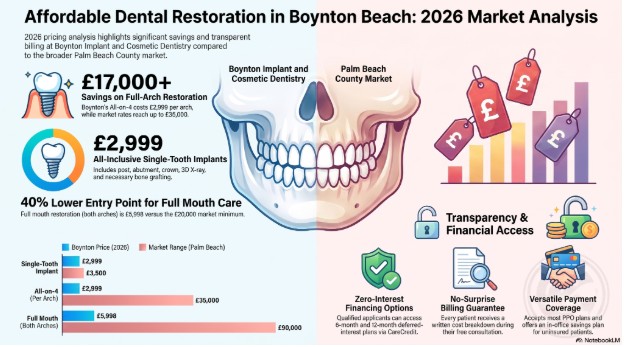
A single-tooth dental implant at Boynton Implant and Cosmetic Dentistry costs $2,999, including the post, abutment, crown, 3D X-ray, and bone grafting at the time of placement. The Palm Beach County market range for the same three-component procedure runs from $3,500 to $4,500 at competing practices as of 2026.
Dr. Berglass provides a written cost breakdown at the free consultation appointment before any clinical work begins.
The $2,999 price covers every component of the single-tooth procedure with no surprise fees and no items billed separately after treatment starts.
All-on-4 full-arch restoration at Boynton Implant and Cosmetic Dentistry costs $2,999 per arch and includes implant placement and same-day temporary teeth. Full mouth restoration (both arches) costs $5,998.
The Palm Beach County market range for comparable full-arch procedures runs $20,000 to $35,000 per arch, placing the practice $17,000 to $32,000 below market for single-arch cases.
CareCredit deferred-interest financing offers qualified applicants 6-month and 12-month zero-interest payment plans.
The practice also accepts most PPO dental insurance plans and offers an in-office savings plan for uninsured patients. The implant pricing page provides the full fee schedule and financing details.
| Option | Boynton Implant Price (2026) | Palm Beach County Market Range | Replacement Cycle | 20-Year Projected Cost |
| Single-tooth dental implant | $2,999 (all-inclusive) | $3,500 to $4,500 | Post: lifetime; crown: 15 to 20 years | $2,999 to $4,499 (crown replacement adds $1,000 to $1,500) |
| All-on-4 (per arch) | $2,999 per arch | $20,000 to $35,000 | Final prosthetic: 15 to 20 years | $2,999 + final prosthetic phase |
| Full mouth (both arches) | $5,998 | $20,000 to $50,000 | Final prosthetic: 15 to 20 years | $5,998 + final prosthetic phase |
| Fixed dental bridge | N/A (not offered as primary) | $2,000 to $5,000 | Every 7 to 15 years | $4,000 to $10,000 |
| Removable partial denture | N/A (not offered as primary) | $500 to $2,500 | Every 5 to 8 years + relines | $2,000 to $10,000 |
| No replacement | $0 | $0 | N/A | $3,000 to $15,000+ (bone grafting, orthodontics, delayed implant) |
What is the best tooth replacement option after extraction?
Dental implants are the best long-term replacement after extraction. The titanium post fuses with the jawbone and prevents bone resorption. Implant success rates exceed 95% at 20 years with standard maintenance.
How long can you go without replacing a missing tooth?
Every month without replacement allows measurable bone loss at the extraction site. Patients who wait longer than 12 months typically require bone grafting before implant placement, adding 3 to 6 months and $500 to $3,000.
Are dental implants better than bridges?
Dental implants preserve jawbone, stand independently without affecting adjacent teeth, and last 15 to 25+ years. Bridges require grinding down two healthy teeth for anchoring and need full replacement every 7 to 15 years.
Can I get a dental implant years after extraction?
Yes. Patients can receive dental implants years after extraction, but most require bone grafting to rebuild the resorbed ridge. CBCT imaging determines how much bone remains and what grafting the case requires.
How much does a single dental implant cost in Boynton Beach?
A single dental implant in Boynton Beach costs $3,000 to $6,000 in 2026, covering the titanium post, abutment, and porcelain crown. Bone grafting, if required, adds $500 to $3,000 depending on graft type and volume.
Do dental implants hurt more than bridges?
Implant placement uses local anesthesia and optional sedation. Most patients report soreness lasting 3 to 5 days. Bridge preparation involves drilling two healthy teeth, which causes sensitivity lasting several weeks.
What is the cheapest way to replace a missing tooth?
A removable partial denture has the lowest upfront cost, ranging from $500 to $2,500. Partials require replacement every 5 to 8 years, do not prevent bone loss, and restore only 50% to 60% of chewing function.
Can I get a dental implant on the same day as the extraction?
Same-day implant placement is an option for patients with adequate bone volume, no active infection, and stable soft tissue at the extraction site. Dr. Berglass evaluates same-day candidacy using CBCT imaging at the consultation visit.

About Dr. Berglass
Dr. Michael Berglass, a dedicated dentist with over 25 years of experience, specializes in dental implants, cosmetic, and general dentistry in Boynton Beach, Florida. A proud alumnus of Stony Brook School of Dental Medicine (DDS, 1996), Dr. Berglass further honed his expertise with residencies in general practice and dental implants at North Shore-Long Island Jewish Hospital. His journey in dentistry has taken him from New York to North Carolina, and now to Florida, where he continues to offer top-notch dental care. Known for his wit and intellect, Dr. Berglass makes every patient's visit comfortable. A member of the American Dental Association and Florida Dentists' Association, he stays at the forefront of dental advancements. Dr. Berglass is committed to providing exceptional care and looks forward to welcoming you to his practice.
Reason To Smile

Phone
Address
2415 Quantum Blvd
Boynton Beach, FL 3342
Office Hours
Mon - Thurs: 8:30AM-5PM
Fri: 8:30AM-1PM
Sat - Sun: Closed


