
Originally published: October 2026 | Reviewed by Dr. Michael Berglass
Bone Graft Second Opinion: Told a Graft Is Needed Before Implants?

A bone graft second opinion is an independent review of whether a patient’s jaw has enough bone to support a dental implant without additional grafting.
The review looks at how the bone was measured, which imaging was used, and whether dental implants could be placed another way.
A graft is sometimes the right step and sometimes one of several reasonable options. Boynton Implant & Cosmetic Dentistry, an implant and cosmetic dental practice in Boynton Beach, Florida, offers free second opinions with Dr. Michael Berglass.
Being told more surgery is needed can feel discouraging. Dr. Berglass invites patients to talk it through during a free second opinion in Boynton Beach.
A bone graft is not always needed before a dental implant. Grafting is recommended when the bone at the planned site is too thin, too short, or too soft to hold an implant securely.
The American Academy of Periodontology states in its overview of implant procedures that a key to implant success is the quantity and quality of the bone where the implant is placed.
Bone often changes after a tooth is lost or removed, which is why a site that held a tooth for decades may later lack volume.
Many implant sites have enough bone as they are. Others need a small graft placed during the implant visit, and some need a separate bone grafting procedure followed by months of healing.
Recommendations should follow measurements of the individual site, so a patient is entitled to know what was measured and how.
A dentist measures bone with a clinical exam and dental imaging. Imaging supplies the anatomical measurements: the height and width of the ridge and the position of nearby nerves and sinuses.
Bone quality is a separate matter, since an image only estimates density and the surgeon’s assessment during the procedure completes the picture.
Imaging type matters for this question. The U.S. Food and Drug Administration explains that dental cone-beam CT provides three-dimensional information, while conventional dental X-rays provide two-dimensional information. A two-dimensional image shows bone height but not the full width of the ridge, and width is frequently a deciding measurement for grafting.
The FDA also recommends cone-beam CT only when necessary for diagnosis or treatment, because the scan generally involves more radiation than conventional dental X-rays.
A three-dimensional CBCT scan is therefore weighed on a case-by-case basis. A second opinion asks whether the images already taken show enough detail for the graft decision or whether a different image would change the answer.
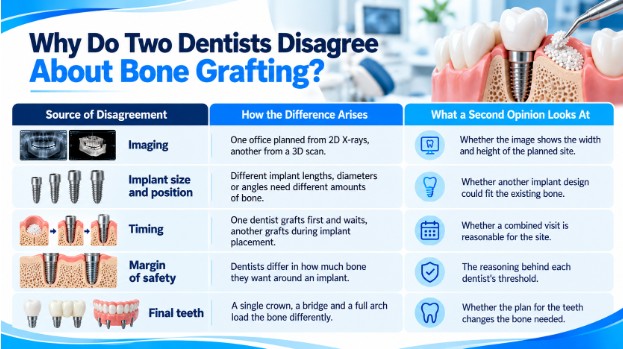
Two dentists disagree about bone grafting because the decision rests on measurements, implant choices, and judgment, and each of those can differ between offices. A disagreement does not mean either dentist was careless.
| Source of Disagreement | How the Difference Arises | What a Second Opinion Looks At |
| Imaging | One office planned from 2D X-rays, another from a 3D scan | Whether the image shows the width and height of the planned site |
| Implant size and position | Different implant lengths, diameters, or angles need different amounts of bone | Whether another implant design could fit the existing bone |
| Timing | One dentist grafts first and waits; another grafts during implant placement | Whether a combined visit is reasonable for the site |
| Margin of safety | Dentists differ in how much bone they want around an implant | The reasoning behind each dentist’s threshold |
| Final teeth | A single crown, a bridge, and a full arch load the bone differently | Whether the plan for the teeth changes the bone needed |
A graft recommendation and a no-graft recommendation can both be defensible for the same site. The useful question is what each recommendation rests on, and a patient who knows the measurements behind each plan can weigh the two fairly.
A plan that avoids a graft only by accepting too little bone around the implant is a compromise, not an alternative, and a careful review says so.
A graft recommendation is easier to accept once measurements are explained. Boynton Implant & Cosmetic Dentistry welcomes patients to ask for clarity on any plan.
If you’re ready to get started, call us now!
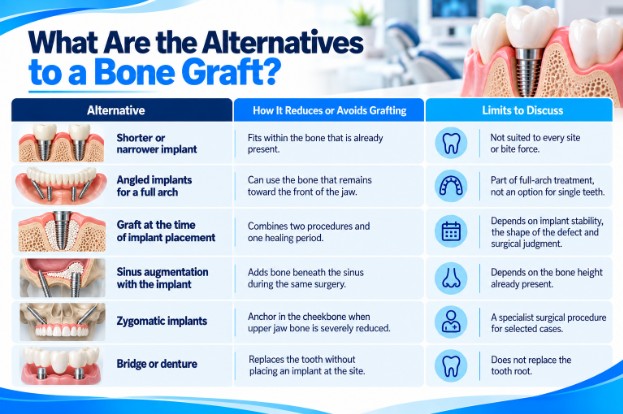
Alternatives to a separate bone graft include a different implant size, a different implant angle, a graft placed during the implant visit, and a different way of replacing the tooth. Each alternative suits some mouths and not others.
| Alternative | How It Reduces or Avoids Grafting | Limits to Discuss |
| Shorter or narrower implant | Fits within the bone that is already present | Not suited to every site or bite force |
| Angled implants for a full arch | Can use the bone that remains toward the front of the jaw | Part of full-arch treatment, not an option for single teeth |
| Graft at the time of implant placement | Combines two procedures and one healing period | Depends on implant stability, the shape of the defect, and surgical judgment |
| Sinus augmentation with the implant | Adds bone beneath the sinus during the same surgery | Depends on the bone height already present |
| Zygomatic implants | Anchor in the cheekbone when upper jaw bone is severely reduced | A specialist surgical procedure for selected cases |
| Bridge or denture | Replaces the tooth without placing an implant at the site | Does not replace the tooth root |
These options are not interchangeable. Researchers have compared shorter implants directly with sinus lifts in the upper back jaw.
A 2014 Cochrane review concluded that the evidence was insufficient to show whether sinus lifts were more or less successful than short implants up to one year after loading, and it found more complications at sites treated with sinus lifts.
Later research points the same way. A 2024 network meta-analysis in BMC Oral Health reported that short implants achieved clinical outcomes comparable to longer implants placed with a sinus lift.
The authors concluded that treatment selection should be individualised to the patient’s condition.
The American Association of Oral and Maxillofacial Surgeons notes that implants can be placed at the same time as a sinus augmentation or as a separate procedure.
Combining the two depends on implant stability on the day, the size and shape of the bone defect, and the surgeon’s judgment.
The same organisation describes zygomatic implants as an option for patients who may not be candidates for traditional implants because of upper-jaw bone loss. Zygomatic implants are a specialist procedure for selected cases and do not replace a routine single-tooth implant.
Full-arch patients have an added path, since All-on-4 treatment places the rear implants at an angle to use the bone that remains. The scan and the design of the final teeth decide whether that approach fits a given patient.
A bone graft adds a procedure fee and, when the graft is done as a separate step, several months of healing before the implant is placed. The graft material, the need for a membrane, the surgery’s complexity, and the required healing all affect both numbers.
Timing has the larger effect on the calendar. The American Association of Oral and Maxillofacial Surgeons explains that healing after bone grafts varies by donor site, recipient site, and the patient’s overall health.
A staged graft means two surgeries and two healing periods, while a graft placed with the implant shares one. Graft healing is also only part of the calendar, because the implant then needs its own healing time before the final crown is attached.
Cost depends on how the office builds its fees. Implant prices at Boynton Implant & Cosmetic Dentistry include the implant placement, the abutment, the crown, the 3D X-ray, and any bone graft done at the time of implant placement, as listed on the practice’s pricing page.
A quote from another office may list the graft, the membrane, and the scan as separate lines, so the totals are comparable only after each line is matched. The pricing page describes grafts done at the time of implant placement, so a graft performed as a separate earlier procedure is a point to confirm with the office.
A bone graft is the right recommendation when the measured bone cannot hold an implant securely, and no reasonable alternative fits the site. A second opinion confirms a graft plan in those cases, and the confirmation has value of its own.
Grafting is commonly appropriate in situations such as those below, subject to the surgical and restorative plan for the individual patient:
Health history also matters, since the American Dental Association notes in its patient information on implants that chronic illnesses such as diabetes may interfere with healing after surgery.
A second opinion also has limits. The review is a professional judgment based on an exam and the available records, and it cannot promise one correct answer. The patient makes the final decision before starting any major dental work.
A patient should bring the records behind the first recommendation, so the second dentist starts from the same evidence. Missing records can mean repeating an image or an exam.
As general guidance for patients, a review of a graft recommendation moves through five steps: the records, the imaging, the proposed implant position and size, the risks of each approach, and the recommendation. Patients preparing for the visit can borrow from the questions worth asking any implant dentist.
A patient should leave knowing four things: what the exam and images showed, which treatment alternatives fit the site, what remains uncertain, and what the next step would be. Asking for those points in writing makes it easier to compare two opinions.
Can a dental implant be placed without a bone graft?
A dental implant can be placed without a bone graft when the planned site has enough bone height, width, and density to hold the implant. The dentist confirms the measurements with an exam and imaging. Many implant sites need no graft.
How much bone is needed for a dental implant?
A dental implant needs enough bone to surround it on every side and hold it steady while it heals. The exact amount depends on the implant’s length and diameter, the location in the jaw, and the bite forces, so no single number fits every patient.
Does a CBCT scan show bone loss better than a standard X-ray?
A CBCT scan shows bone in three dimensions, while a standard dental X-ray shows two. The added dimension reveals ridge width, which a flat image cannot. The FDA recommends cone-beam CT only when necessary, so dentists order the scan when the decision calls for it.
How long does a bone graft heal before an implant can be placed?
A bone graft placed as a separate procedure generally takes several months to heal before an implant is placed. Healing time varies with the graft’s size and location and the patient’s health. The implant then needs its own healing time before the final crown.
Is a sinus lift the same as a bone graft?
A sinus lift is one type of bone graft. The procedure, also called sinus augmentation, adds bone between the upper jaw and the maxillary sinus to create a base for implants in the upper back teeth. Other grafts rebuild ridge width or fill extraction sockets.
Can a bone graft and a dental implant be done at the same time?
In some cases, a bone graft and a dental implant can be done in the same visit. The decision depends on implant stability on the day, the size and shape of the defect, and the surgeon’s judgment. Larger defects usually call for grafting first.
What is a dental bone graft made of?
A dental bone graft is made of the patient’s own bone, donor bone from a tissue bank, animal-derived bone, or a synthetic material. Each source has advantages and trade-offs. The dentist selects the material according to the size of the defect and the site.
Is a bone graft included in the price of a dental implant?
A bone graft is included in some implant prices and billed separately in others. Boynton Implant & Cosmetic Dentistry lists implant prices that include any bone graft done at the time of implant placement. When comparing quotes, ask what each total covers.
A bone graft is the right step before some dental implants and an avoidable one before others, and the difference lies in the bone measured at the planned site.
Two careful dentists can reach different recommendations because they used different imaging, chose different implant designs, or prefer different safety margins.
A second opinion reviews what was measured, which image the measurement came from, and whether an alternative fits the site without giving up too much bone support.
The review may confirm the graft plan, and that confirmation carries its own value. Patients who bring the first office’s records give both opinions the same evidence to work from.
Confidence in an implant plan begins with understanding the bone. Dr. Berglass invites patients to schedule a relaxed visit for a free second opinion.

About Dr. Berglass
Dr. Michael Berglass, a dedicated dentist with over 25 years of experience, specializes in dental implants, cosmetic, and general dentistry in Boynton Beach, Florida. A proud alumnus of Stony Brook School of Dental Medicine (DDS, 1996), Dr. Berglass further honed his expertise with residencies in general practice and dental implants at North Shore-Long Island Jewish Hospital. His journey in dentistry has taken him from New York to North Carolina, and now to Florida, where he continues to offer top-notch dental care. Known for his wit and intellect, Dr. Berglass makes every patient's visit comfortable. A member of the American Dental Association and Florida Dentists' Association, he stays at the forefront of dental advancements. Dr. Berglass is committed to providing exceptional care and looks forward to welcoming you to his practice.
Reason To Smile

Phone
Address
2415 Quantum Blvd
Boynton Beach, FL 3342
Office Hours
Mon - Thurs: 8:30AM-5PM
Fri: 8:30AM-1PM
Sat - Sun: Closed


