
Originally published: October 2026 | Reviewed by Dr. Michael Berglass
Dental Implant Second Opinion in Boynton Beach, FL
A dental implant second opinion is an independent review of another dentist’s diagnosis, imaging, treatment plan, and fees before removing any tooth or placing any implant.
The review evaluates whether the proposed dental implant plan is clinically justified, whether reasonable alternatives exist, and whether the fees are complete and clearly explained.
Boynton Implant & Cosmetic Dentistry, an implant and cosmetic dental practice in Boynton Beach, Florida, offers free second opinions.
Dr. Michael Berglass, a fellowship-trained implant dentist with 25 years of dental experience, leads the practice.
Uncertainty about a treatment plan deserves a calm, careful answer. Dr. Berglass invites patients to schedule a comfortable visit at the Boynton Beach office.
A dental implant second opinion covers the same ground as the first consultation, with one difference: a different dentist reaches the conclusions independently. The second dentist examines the mouth, studies the available images, and reads the proposed plan line by line.
Patients often arrive with a quote and a feeling that something was left unexplained. The American Dental Association’s Code of Ethics states that a dentist should inform the patient of the proposed treatment and any reasonable alternatives.
A second opinion walks the patient through those alternatives in plain language, so the final decision rests on a fuller picture.
A second opinion has limits. Implant planning involves clinical judgment, and two careful dentists can reach different reasonable conclusions from the same mouth.
The review does not guarantee a single correct answer, and it is not a commitment to change dentists. Many patients return to the first office with better questions, which is the purpose of a second look before major dental work begins.
A second opinion is worth getting whenever a treatment plan is large, irreversible, or unclear. Extractions, bone grafts, and full-arch implants cannot be undone, so a review beforehand protects both health and budget.
The situations below commonly lead patients to ask another dentist:
Pressure to sign and missing fee details are two of the red flags that deserve a pause before any agreement is made.
Urgent symptoms follow a different path. New numbness in the lip, chin, or tongue; severe or worsening pain; swelling; fever; or pus around an implant call for prompt contact with the treating dentist or same-day dental care.
A routine second-opinion appointment is not a substitute for urgent evaluation of those symptoms.
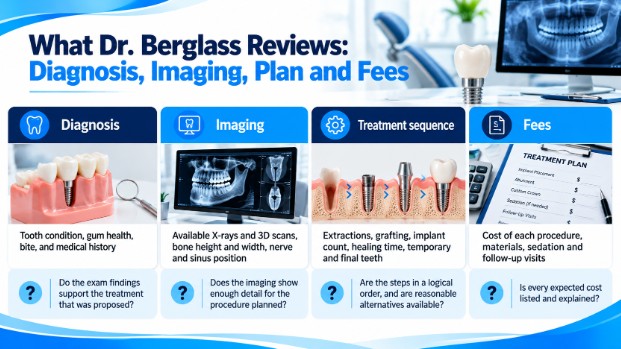
Dr. Berglass reviews four elements of the first plan: the diagnosis, the imaging, the treatment sequence, and the fees. Each element informs the others, so a change in one finding can alter the rest of the plan.
| Element | What Is Reviewed | Question the Review Explores |
| Diagnosis | Tooth condition, gum health, bite, and medical history | Do the exam findings support the treatment that was proposed? |
| Imaging | Available X-rays and 3D scans, bone height and width, nerve and sinus position | Does the imaging show enough detail for the procedure planned? |
| Treatment sequence | Extractions, grafting, implant count, healing time, temporary and final teeth | Are the steps in a logical order, and are reasonable alternatives available? |
| Fees | Cost of each procedure, materials, sedation and follow-up visits | Is every expected cost listed and explained? |
The four elements are linked. A scan showing adequate bone at an implant site can remove a grafting step from the sequence, shortening the timeline and changing the fee. A diagnosis of active gum disease can add treatment before placing any implant.
Imaging is weighed case by case. The U.S. Food and Drug Administration explains that dental cone-beam CT provides three-dimensional information, while conventional dental X-rays provide two-dimensional information.
The FDA also notes that cone-beam CT generally involves more radiation than conventional dental X-rays and recommends the scan only when necessary for diagnosis or treatment.
A two-dimensional image is sufficient for some decisions but not for others, so the review considers whether the imaging fits the proposed procedure.
A large quote is easier to judge once each line is explained. Dr. Berglass welcomes patients to request a review of any implant plan.
If you’re ready to get started, call us now!
A second-opinion visit centers on conversation, a thorough exam, a review of available records, and a clear explanation. The visit is unhurried and focused on information.
The visit begins with what the first dentist recommended and what concerns the patient most. The dentist discusses the medical history at the same time. The American Dental Association notes in its patient information on implants that chronic illnesses such as diabetes may interfere with healing after surgery.
Dr. Berglass thoroughly examines the mouth, including the teeth, gums, and bite. The dentist then compares X-rays and scans from the first visit with what the exam shows.
Whether new imaging is needed is an individual clinical decision. American Dental Association guidance on dental X-rays calls for a clinical examination before taking any images and a good-faith effort to use images from earlier dental exams.
Recent, clear images that cover the planned implant site may be all the review requires. A new image, such as a CBCT scan, is considered when the existing images cannot supply the diagnostic information the decision depends on.
Dr. Berglass then explains where the second opinion agrees with the first plan and where the two differ. Patients are encouraged to ask every question on their list before leaving.
Patients leave a second opinion with a clearer view of the first plan and the reasoning behind the second dentist’s assessment. The outcome depends on what the exam and the records show.
Patients can ask for the findings and any alternative fees in writing. Itemized figures allow a fair side-by-side comparison, which helps patients see how much a second opinion can change the final cost.
Two treatment plans often differ because dentists weigh the same findings differently, rely on different imaging, or work with different materials and laboratories. A difference between plans does not mean one dentist was careless.
| Where Plans Differ | Common Reason | What the Second Opinion Examines |
| Teeth to be removed | One dentist favors saving teeth, another favors replacing them | Which teeth appear restorable, based on the exam and images |
| Bone grafting | Plans rest on different imaging or different readings of the same image | Whether measured bone volume appears to support implants at the planned sites |
| Number of implants | Bone quality, bite force and the design of the final teeth | An implant count suited to the individual’s bone and bite |
| Material of final teeth | Acrylic and zirconia differ in fee and in how each wears and is repaired | Which material fits the patient’s bite, habits and budget |
| Total fee | Office overhead, laboratory choice and items left off the quote | What each quote includes and excludes |
An upper back tooth offers a common illustration. One dentist may plan a sinus lift followed by an implant months later, while another may plan an implant without a lift after measuring bone height on a three-dimensional scan.
Either plan can be reasonable. Bone height is one consideration among several, and bone quality, sinus anatomy, implant length, medical history, and the dentist’s training can each influence the recommendation.
Plan differences fall into three groups. Some reflect reasonable professional preference, some trace back to diagnostic information that one office did not have, and some reveal a proposal that left out a step or a cost. A second opinion helps a patient determine which group a difference falls into.
Fee gaps between offices have several ordinary causes, and understanding why implant quotes vary helps a patient compare offers on equal terms.
Credentials are also worth checking, and any Florida dentist’s license can be confirmed through the Florida Department of Health’s license verification portal.
Boynton Implant & Cosmetic Dentistry offers free consultations and second opinions. Patients can confirm what the visit includes and whether any new imaging would carry a fee when booking.
Records from the first office keep the visit simple. Under section 456.057(6), Florida Statutes, a health care practitioner must furnish copies of a patient’s reports and records, including X-rays, in a timely manner on request.
The same subsection bars a practitioner from conditioning the copies on payment of a fee for services rendered.
Copies are not always free. Section 456.057(17) allows a charge of no more than the actual cost of copying, including reasonable staff time, or the amount set by board rule.
Rule 64B5-17.009 of the Florida Administrative Code addresses copying charges and timely release of dental records.
Cost should never be the reason a patient skips a second look at a major plan. Patients without dental insurance who decide to proceed can also ask about the office’s savings plan and its current terms.
Scheduling a second opinion begins with a phone call or a message through the contact page. The first dentist does not have to be involved.
Patients can call 561-736-1700 during office hours, Monday through Thursday from 8:30 AM to 5 PM and Friday from 8:30 AM to 1 PM. Bringing the treatment plan, the fee estimate, and any recent X-rays or scans gives the review more to work with.
The practice sees patients from Boynton Beach, Lake Worth, Delray Beach, and Boca Raton. Dr. Berglass brings experience from 10 years of practice on Long Island and 13 years in Charlotte, North Carolina, along with fellowship training in implant dentistry.
Is a dental implant second opinion free in Boynton Beach?
Boynton Implant & Cosmetic Dentistry offers a free dental implant second opinion in Boynton Beach. The practice offers free consultations and second opinions. Patients can confirm at booking what the visit includes and whether any new imaging would carry a separate fee.
Do new X-rays or a CBCT scan have to be taken for a second opinion?
New X-rays or a CBCT scan are not automatically required for a second opinion. Recent, clear images from the first office can often be used. After a clinical exam, the dentist decides whether existing images provide enough diagnostic information for the specific procedure being considered.
Will the first dentist be told about the second opinion?
The first dentist does not need to be told about a second opinion. Florida patients can request copies of their own records and bring them to the visit. Seeking another view is a normal part of deciding on major dental treatment.
How long does a second-opinion visit take?
The length of a second-opinion visit depends on the size of the treatment plan and the records available. A single-implant plan with recent images takes less time to review than a full-arch plan that involves extractions, grafting, and several stages of treatment.
What should a patient do when two dentists recommend different plans?
A patient facing two different plans should ask each dentist to explain the reasoning in writing. Comparing the diagnosis, the imaging used, the number of implants, and the itemized fees shows where the plans differ and what each recommendation is based on.
Can a second opinion be done after treatment has started?
Yes, a second opinion is possible after treatment has started. Another dentist can examine completed work, review the remaining steps, and offer a view on whether the plan still fits. The earlier the review happens, the more options usually remain open to the patient.
Should numbness or severe pain after an implant wait for a second opinion?
Numbness or severe pain after an implant should not wait for a second-opinion appointment. New numbness, worsening pain, swelling, fever, or pus needs prompt contact with the treating dentist or same-day dental care. A second opinion can follow once the urgent problem has been evaluated.
Can a dentist in Florida charge for copies of dental records?
A dentist in Florida can charge for copies of dental records. Section 456.057(17), Florida Statutes, limits the charge to the actual cost of copying, including reasonable staff time, or the amount set by board rule. Section 456.057(6) bars withholding copies over unpaid treatment fees.
Peace of mind before implant treatment starts with one unhurried conversation. Dr. Berglass invites patients to book a visit for a free second opinion.

About Dr. Berglass
Dr. Michael Berglass, a dedicated dentist with over 25 years of experience, specializes in dental implants, cosmetic, and general dentistry in Boynton Beach, Florida. A proud alumnus of Stony Brook School of Dental Medicine (DDS, 1996), Dr. Berglass further honed his expertise with residencies in general practice and dental implants at North Shore-Long Island Jewish Hospital. His journey in dentistry has taken him from New York to North Carolina, and now to Florida, where he continues to offer top-notch dental care. Known for his wit and intellect, Dr. Berglass makes every patient's visit comfortable. A member of the American Dental Association and Florida Dentists' Association, he stays at the forefront of dental advancements. Dr. Berglass is committed to providing exceptional care and looks forward to welcoming you to his practice.
Reason To Smile

Phone
Address
2415 Quantum Blvd
Boynton Beach, FL 3342
Office Hours
Mon - Thurs: 8:30AM-5PM
Fri: 8:30AM-1PM
Sat - Sun: Closed


