
Originally published: October 2026 | Reviewed by Dr. Michael Berglass
Not a Candidate for Dental Implants? What a Second Review Looks At

When a patient is told they are not a candidate for dental implants, it means a dentist judged that implants placed today would carry too much risk, either to the implant’s healing or to the patient’s overall health.
The judgment usually rests on one of four findings: too little bone, active gum disease, a health condition that slows healing, or a medication concern. Several of those findings can be treated or managed before implant surgery.
Boynton Implant & Cosmetic Dentistry, an implant and cosmetic dental practice in Boynton Beach, Florida, offers free second opinions with Dr. Michael Berglass.
Hearing no after hoping for implants is disheartening. Dr. Berglass invites patients to share their situation during a free second opinion in Boynton Beach.
A dentist says someone is not a candidate for implants when the exam, images, or medical history point to a raised risk that the implant will not heal into the bone. The finding describes the mouth and the health picture on the day of the exam.
The American Academy of Periodontology lists three traits of an ideal candidate in its overview of implant procedures: good general and oral health, adequate jawbone, and healthy gum tissue free of periodontal disease. A patient who falls short on one trait may be told no.
The reasons given most often fall into the groups below:
Each reason calls for a different response, which is why the specific reason matters more than the verdict. Many of the same concerns can prevent implant treatment from moving forward.
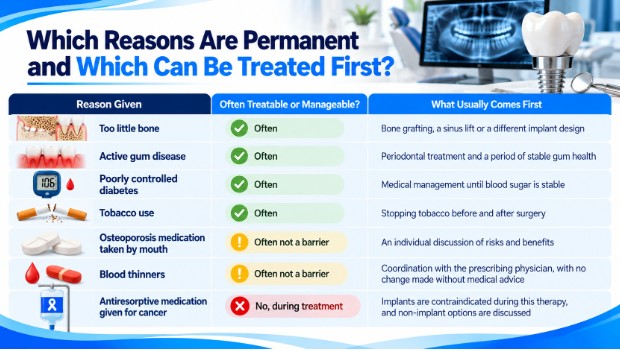
Most reasons for being turned down can be treated or managed first, and one reason, antiresorptive medication given for cancer, is a contraindication while that treatment continues. The table groups the common reasons by what usually happens next.
| Reason Given | Often Treatable or Manageable? | What Usually Comes First |
| Too little bone | Often | Bone grafting, a sinus lift, or a different implant design |
| Active gum disease | Often | Periodontal treatment and a period of stable gum health |
| Poorly controlled diabetes | Often | Medical management until blood sugar is stable |
| Tobacco use | Often | Stopping tobacco before and after surgery |
| Osteoporosis medication taken by mouth | Often not a barrier | An individual discussion of risks and benefits |
| Blood thinners | Often not a barrier | Coordination with the prescribing physician, with no change made without medical advice |
| Antiresorptive medication given for cancer | No, during treatment | Implants are contraindicated during this therapy, and non-implant options are discussed |
Bone volume and gum disease can change with treatment, while diabetes, tobacco use, and long-term medication are ongoing factors that are managed and not removed. Treatable causes still take time to address, and treatment does not guarantee implants will follow.
Gum health is a common starting point, since untreated gum disease threatens the bone an implant depends on.
Diabetes, osteoporosis medication, and smoking each affect how implant surgery is planned, and none of the three rules out implants automatically. The level of control, the medication involved, and the patient’s habits decide the answer.
The American Dental Association states in its guidance on diabetes that implant placement is generally safe and reliable in patients with properly controlled diabetes.
The same guidance says poorly controlled diabetes can give implants an unpredictable prognosis and that elective dental treatment may need to wait until the condition is stable.
The same guidance advises clinicians to consider HbA1c values when assessing risk before implant placement. An HbA1c result is one factor in an individual assessment and not a pass-or-fail cutoff, and it is a useful figure to bring for patients considering implants with diabetes.
Osteoporosis itself is rarely the obstacle; medication usually is. American Dental Association guidance on osteoporosis medications describes medication-related osteonecrosis of the jaw as a rare but serious side effect of antiresorptive drugs.
The guidance reports the condition in between 0.001% and 0.01% of patients taking oral bisphosphonates for osteoporosis.
Those figures describe how often the condition is reported in that patient group. The figures are not implant failure rates, and they do not predict one patient’s risk after implant surgery.
For osteoporosis therapy, the guidance reports a 2011 expert panel’s view that antiresorptive therapy does not appear to be a contraindication to dental implant placement, and it adds that larger, longer-term studies are needed.
A decision about implants with osteoporosis therefore starts with the exact drug, the dose, and how long it has been taken.
Cancer treatment is a separate category. The same condition is reported in between 1% and 10% of patients receiving intravenous bisphosphonates for cancer that has spread to bone.
American Dental Association guidance on oncology agents states that dental implants are contraindicated during antiresorptive or targeted cancer therapy and advises avoiding jaw surgery where possible.
Patients in that group should tell the dentist about the treatment, and the guidance recommends a dental assessment before the therapy begins where feasible.
Tobacco use slows healing after implant surgery, as the American Dental Association notes in its patient information on implants. A dentist may ask a patient to stop before surgery and during healing.
A patient who cannot stop should expect an honest conversation about the added risk and the alternatives.
If you’re ready to get started, call us now!
As general guidance, a second dentist checks the same four areas as the first: bone, gums, health, and medication. Those four areas decide whether someone is a good candidate, and the second review may differ in the imaging used, the medical details gathered, and the treatment options considered.
Bone measurements depend on the image behind them. A second dentist first checks whether the existing X-rays or 3D scan answer the bone question before considering any new imaging.
A medical concern is only as precise as the information behind it. A medication’s name and dose, how long it has been taken, and recent test results can change a risk assessment. A second dentist may ask the patient’s physician for those details before giving a view.
Blood thinners are a common example. The American Dental Association’s guidance on anticoagulant medications states that most patients do not need to alter that therapy before a dental procedure and that any change should follow the advice of the patient’s physician. Patients should never stop or change a prescribed blood thinner on their own.
A health condition does not have to end the conversation about implants. Boynton Implant & Cosmetic Dentistry welcomes patients to explore their options without pressure.
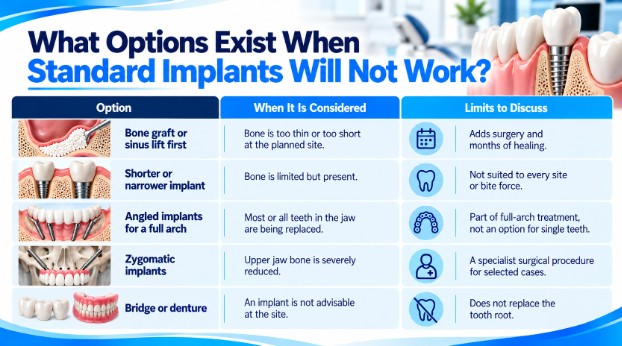
When standard implants will not work, options include rebuilding the bone, changing the implant design, or replacing the teeth without an implant at that site. Each option fits some patients and not others.
| Option | When It Is Considered | Limits to Discuss |
| Bone graft or sinus lift first | Bone is too thin or too short at the planned site | Adds surgery and months of healing |
| Shorter or narrower implant | Bone is limited but present | Not suited to every site or bite force |
| Angled implants for a full arch | Most or all teeth in the jaw are being replaced | Part of full-arch treatment, not an option for single teeth |
| Zygomatic implants | Upper jaw bone is severely reduced | A specialist surgical procedure for selected cases |
| Bridge or denture | An implant is not advisable at the site | Does not replace the tooth root |
These options are not interchangeable. A 2024 network meta-analysis in BMC Oral Health compared short implants with longer implants placed with a sinus lift in the upper back jaw where bone height is limited.
The analysis reported comparable clinical outcomes, and its authors concluded that treatment selection should be individualized.
The American Association of Oral and Maxillofacial Surgeons describes zygomatic implants as an option for patients who may not be candidates for traditional implants because of upper-jaw bone loss.
Oral and maxillofacial surgeons place zygomatic implants, and they do not replace a routine single-tooth implant. Patients can ask any office which options it provides and which it refers to a specialist for.
Patients with limited bone can also ask whether bone grafting would make a standard implant possible later.
A second opinion that supports implant treatment leads to a treatment plan, and any conditions that need attention are addressed before surgery. The plan outlines the order of steps and who is responsible for each.
A patient should come away from the review knowing four things: what the exam and images showed, which reason for the first decision still stands, what would need to happen before implants, and what the alternatives are. Asking for those points in writing makes the two opinions easier to compare.
A second opinion can also agree with the first dentist. A confirmed no is still useful, since the patient can stop searching and choose among other ways to replace teeth.
The review is a professional judgment based on an exam and the available records, and it cannot promise a particular answer.
Boynton Implant & Cosmetic Dentistry offers free consultations and second opinions, and patients can confirm what the visit includes at booking before planning any major dental work.
Can someone with bone loss still get dental implants?
In many cases, someone with bone loss can still get dental implants. A bone graft or sinus lift can rebuild the site, and a shorter or narrower implant sometimes fits the remaining bone. The dentist decides based on an exam and imaging of the site.
Is there an age limit for dental implants?
Age alone does not rule out dental implants. The American Dental Association notes that health is more of a factor than age. An older adult in good general health with adequate bone and healthy gums can be a suitable candidate after an exam.
Can gum disease be treated before implants are placed?
Yes, gum disease can be treated before implants are placed. Periodontal treatment comes first, and the gums need to stay healthy afterward. The American Academy of Periodontology lists healthy gum tissue free of periodontal disease as one trait of an ideal implant candidate.
Do blood thinners or osteoporosis medication prevent implants?
Blood thinners and osteoporosis medication do not automatically prevent implants. The American Dental Association states that most patients do not need to alter anticoagulant therapy before dental procedures, and patients should never stop a prescribed medication on their own. Osteoporosis medication is assessed individually.
How long after an extraction can an implant be placed?
In some cases, an implant can be placed the day of an extraction; in others, it can be placed after several months of healing. The timing depends on infection at the site, the bone that remains, and whether a graft is needed first.
Can dental implants be placed during cancer treatment with bone-strengthening drugs?
Dental implants are contraindicated during antiresorptive or targeted cancer therapy, according to American Dental Association guidance on oncology agents. The guidance also advises avoiding jaw surgery when possible. Patients receiving that treatment should tell the dentist and discuss non-implant ways of replacing teeth.
Can smokers get dental implants?
Smokers can get dental implants, though tobacco use slows healing after surgery. Dentists often ask patients to stop before surgery and during healing. A patient who continues to smoke should discuss the added risk and the alternatives with the dentist before deciding.
Does being turned down by one dentist mean every dentist will say no?
Being turned down by one dentist does not mean every dentist will say no. Dentists differ in training, imaging, and the treatment options offered. A second dentist may reach the same conclusion, identify a condition to treat first, or suggest a different approach.
A finding that a patient is not a candidate for dental implants reflects the risk a dentist saw on the day of the exam. The reason behind the finding decides what happens next.
Some reasons can be treated, some are managed over time with the patient’s physician, and antiresorptive treatment for cancer is a contraindication while that therapy continues.
A second review may agree with the first dentist, point to a condition to address first, or identify another way to replace the teeth.
No patient should stop a prescribed medication to qualify for implants. Bringing records, a medication list, and recent test results gives the second dentist a complete picture.
A clear explanation makes the next decision easier. Dr. Berglass invites patients to book a comfortable visit for a free second opinion on candidacy.

About Dr. Berglass
Dr. Michael Berglass, a dedicated dentist with over 25 years of experience, specializes in dental implants, cosmetic, and general dentistry in Boynton Beach, Florida. A proud alumnus of Stony Brook School of Dental Medicine (DDS, 1996), Dr. Berglass further honed his expertise with residencies in general practice and dental implants at North Shore-Long Island Jewish Hospital. His journey in dentistry has taken him from New York to North Carolina, and now to Florida, where he continues to offer top-notch dental care. Known for his wit and intellect, Dr. Berglass makes every patient's visit comfortable. A member of the American Dental Association and Florida Dentists' Association, he stays at the forefront of dental advancements. Dr. Berglass is committed to providing exceptional care and looks forward to welcoming you to his practice.
Reason To Smile

Phone
Address
2415 Quantum Blvd
Boynton Beach, FL 3342
Office Hours
Mon - Thurs: 8:30AM-5PM
Fri: 8:30AM-1PM
Sat - Sun: Closed


