
Originally published: October 2026 | Reviewed by Dr. Michael Berglass
Full Mouth Extraction Second Opinion: Told Every Tooth Has to Come Out?

A full mouth extraction second opinion is an independent review of a plan to remove every remaining tooth, done before any tooth is removed.
The review asks, tooth by tooth, whether each tooth can be restored and whether dental implants or another replacement is needed across the whole jaw.
Extraction cannot be reversed, so the plan deserves review before treatment starts. Boynton Implant & Cosmetic Dentistry, an implant and cosmetic dental practice in Boynton Beach, Florida, offers free second opinions with Dr. Michael Berglass.
Losing every tooth is a serious step, and questions are reasonable. Dr. Berglass invites patients to talk before deciding during a free second opinion.
Removing all teeth may be appropriate when the remaining teeth have a poor long-term outlook and no reasonable alternative serves the patient better.
The decision weighs each tooth’s outlook, the bone and gum support, the overall treatment plan, medical factors, and the patient’s own preferences.
The American Dental Association explains in its patient information on extractions that a tooth is usually removed because of disease, trauma, or crowding. Advanced gum disease is one reason given for full-mouth plans.
The American Academy of Periodontology describes in its overview of gum disease how periodontitis destroys the tissues and bone that support the teeth, until teeth become loose and may need to be removed.
Periodontists assign the disease a stage from initial to severe, so the stage is a useful detail to ask about.
Full extraction can be the right plan. A mouth in which every tooth has lost its support or is damaged beyond repair may be better served by a complete replacement, such as All-on-4 treatment or dentures, than by repeated repairs.
Teeth can usually be saved when they can be treated and offer a reasonable long-term outlook. Those are two separate questions, since a tooth that can be repaired today may still have too little support to last.
Two professional bodies set out the general principle. The American Association of Endodontists advises patients on saving natural teeth and asks whether root canal treatment is an option whenever an extraction is recommended.
Gum disease does not always end in tooth loss. The American Academy of Periodontology notes that many patients do not require additional treatment after scaling and root planing, a deep cleaning of the root surfaces.
The same page states that these procedures have limitations, that gum surgery may be recommended when they fall short, and that most patients need ongoing maintenance. A plan to keep teeth therefore also depends on the patient’s ability to keep up that care.
That guidance describes gum disease patients in general. It does not show that teeth in an advanced case will respond the same way, and each patient’s outcome depends on disease severity, remaining bone support, and each tooth’s outlook.
A patient told that gum disease is the reason for full extraction can ask whether the dentist considered other treatment first. Patients with loose or bleeding gums can ask how dentists treat gum disease before accepting that every tooth is lost.
Treatment plans for the same mouth differ because dentists weigh the long-term outlook of weak teeth differently and plan toward different final results. Differences between plans do not mean either dentist was careless.
| Source of Difference | How the Difference Arises | What a Second Opinion Looks At |
| Outlook for weak teeth | One dentist expects a tooth to last with treatment; another expects it to fail | The findings behind each prediction |
| Diagnostic records | Plans rest on different images or gum measurements | Whether the records show each tooth clearly |
| Final restoration planned | An implant-supported full-arch restoration replaces every tooth in the jaw, while a tooth-supported bridge or a partial denture keeps and relies on some natural teeth | Whether the choice of final teeth is driving the extractions |
| Treatment preference | Some dentists favor saving teeth; others favor replacing them | Which approach fits the exam findings |
The American Dental Association’s Code of Ethics states that a dentist should inform the patient of the proposed treatment and any reasonable alternatives.
A patient who was shown only one option can ask what the alternatives were and why they were set aside.
A plan this permanent deserves a clear explanation of every tooth. Boynton Implant & Cosmetic Dentistry welcomes patients to ask their questions without pressure.
If you’re ready to get started, call us now!
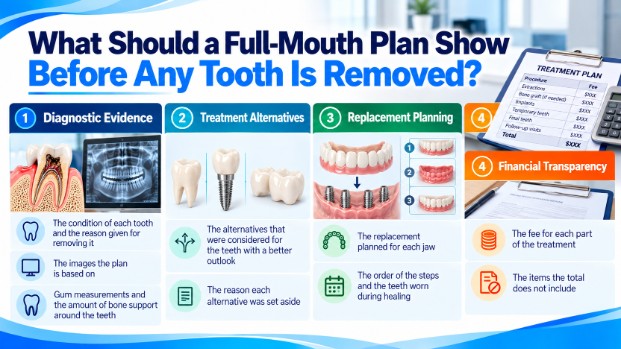
A full-mouth plan should show why each tooth cannot be kept, what will replace the teeth, and what the patient will wear while healing. A patient can ask for each of the items below before agreeing to treatment.
A plan with no tooth-by-tooth reasoning and a single total fee shows two of the red flags worth pausing over. Asking the first office for the missing detail is a reasonable first step.
Several options sit between keeping every tooth and replacing a whole arch, and the right one depends on how many teeth are sound. The table sets out the main choices.
| Option | What It Involves | Limits to Discuss |
| Treat and keep the teeth | Gum treatment, fillings, crowns, or root canal treatment | Requires ongoing maintenance and a reasonable long-term outlook for each tooth |
| Remove some teeth and keep others | A removable partial denture anchored to the remaining teeth | Depends on whether the teeth that stay are strong enough to anchor the denture |
| Replace individual teeth | Single implants, or a conventional bridge supported by neighboring teeth | An implant needs adequate bone, and a tooth-supported bridge needs neighboring teeth able to carry it |
| Replace one arch only | Full-arch treatment in one jaw while the other keeps its teeth | Depends on the condition of each jaw |
| Replace all teeth | Complete dentures or an implant-supported full-arch restoration | Removes every natural tooth permanently |
The American College of Prosthodontists explains in its overview of dentures that complete dentures replace all teeth, while a removable partial denture replaces some teeth and uses the remaining teeth as anchors.
The two jaws are also assessed separately, and treating one or both arches is a decision in itself. These options are not interchangeable, and keeping weak teeth can mean further treatment later.
Bone is part of the comparison. The American Association of Oral and Maxillofacial Surgeons notes in its guidance on bone grafts that tooth loss or extraction can alter surrounding bone and affect future dental treatment. A second opinion weighs both prospects for the individual patient.
In general, a second opinion on full-mouth extraction involves an exam, a review of existing records, and a tooth-by-tooth assessment of what can be kept. The review is most useful before any tooth has been removed.
A patient should come away knowing four things: which teeth the second dentist would keep, which the second dentist would also remove, what the alternatives are, and what remains uncertain.
A second opinion may agree that full extraction is the sound plan, which settles the question before major dental work begins.
Urgent problems come first. Mayo Clinic’s guidance on tooth abscesses advises seeing a dentist promptly for any signs of an abscess.
The same guidance advises going to an emergency room for fever with facial swelling when a dentist cannot be reached, and for any trouble breathing or swallowing.
The wider plan can be reviewed once an urgent problem is treated. Patients can call 561-736-1700 during office hours, Monday through Thursday from 8:30 AM to 5 PM and Friday from 8:30 AM to 1 PM.
The review is a professional judgment based on an exam and the available records, and it cannot promise a particular answer.
Boynton Implant & Cosmetic Dentistry offers free consultations and second opinions, and patients can confirm what the visit includes at booking before scheduling any tooth extractions.
Is it better to save natural teeth or replace them with implants?
Saving natural teeth is generally preferred when they can be restored and kept healthy. The American Association of Endodontists states that no denture, bridge, or implant will look, feel, and function as well as a natural tooth. Teeth that cannot be restored are better replaced.
Can gum disease be treated instead of extracting teeth?
In many cases, gum disease can be treated, which may allow some teeth to be kept. The result depends on the disease severity and the remaining bone support. Teeth that have lost most supporting bone may still need to be removed.
How many teeth can be removed in one visit?
No fixed number of teeth applies to every patient. The number removed in one visit depends on the patient’s health, the difficulty of the extractions, and the type of anesthesia used. The dentist sets the plan after an exam and a review of medical history.
What happens to the jawbone after all teeth are removed?
The jawbone changes after teeth are removed. The American Association of Oral and Maxillofacial Surgeons notes that losing or extracting a tooth can alter the surrounding bone and affect future dental treatment. Dentists plan the replacement teeth with that change in mind.
Does getting a second opinion delay treatment?
A second opinion adds one visit before treatment begins. The visit takes place before any tooth is removed. Treat urgent problems such as swelling or fever first, then review the broader plan once the urgent issue is under control.
Is a root canal an alternative to pulling a tooth?
A root canal is an alternative to extraction for some teeth. The American Association of Endodontists advises patients to ask whether root canal treatment is an option whenever a dentist recommends extraction. An exam and images show whether the tooth can be restored afterward.
Can some teeth be kept to hold a partial denture?
Some teeth can be kept to hold a partial denture when those teeth are healthy enough. The American College of Prosthodontists explains that a removable partial denture uses the remaining teeth as anchors. The dentist assesses whether the teeth that stay can carry that load.
Does every dentist recommend the same teeth for removal?
Dentists do not always recommend the same teeth for removal. Dentists differ in how they judge the outlook for weak teeth and in the final restoration they plan toward. A second dentist reviews the same teeth independently and explains the reasoning for each.
A plan to remove every tooth deserves a second look because extraction is permanent. The decision weighs each tooth’s long-term outlook within the overall treatment plan, and a sound plan explains the reasoning, the replacement, and the cost of each step.
Professional guidance favors keeping natural teeth when clinically appropriate, and the response to gum treatment varies with disease severity.
A second opinion may agree with full extraction or point to teeth with a better outlook. Symptoms such as swelling or fever need prompt care first. Bringing the written plan, images, and a medication list supports a careful review.
Confidence in a full-mouth plan begins with understanding each tooth. Dr. Berglass invites patients to schedule a calm visit for a free second opinion.

About Dr. Berglass
Dr. Michael Berglass, a dedicated dentist with over 25 years of experience, specializes in dental implants, cosmetic, and general dentistry in Boynton Beach, Florida. A proud alumnus of Stony Brook School of Dental Medicine (DDS, 1996), Dr. Berglass further honed his expertise with residencies in general practice and dental implants at North Shore-Long Island Jewish Hospital. His journey in dentistry has taken him from New York to North Carolina, and now to Florida, where he continues to offer top-notch dental care. Known for his wit and intellect, Dr. Berglass makes every patient's visit comfortable. A member of the American Dental Association and Florida Dentists' Association, he stays at the forefront of dental advancements. Dr. Berglass is committed to providing exceptional care and looks forward to welcoming you to his practice.
Reason To Smile

Phone
Address
2415 Quantum Blvd
Boynton Beach, FL 3342
Office Hours
Mon - Thurs: 8:30AM-5PM
Fri: 8:30AM-1PM
Sat - Sun: Closed


