
Originally published: May 2026 | Updated: June 2026
Reviewed by Dr. Michael Berglass
Red Flags in a Dental Treatment Plan: What Boynton Beach Patients Need to Know
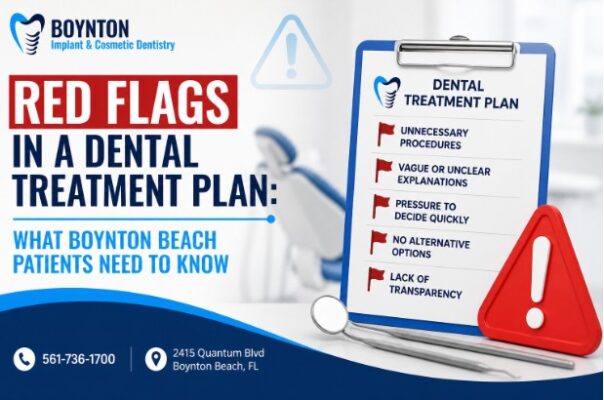
A legitimate dental treatment plan explains every recommended procedure, states the clinical reason behind it, and gives you time to ask questions before you commit.
When a plan does the opposite — rushing you toward expensive work, skipping explanations, or piling on procedures you didn’t expect — that is a signal to slow down and scrutinize.
Dr. Michael Berglass, D.D.S., of Boynton Implant and Cosmetic Dentistry in Boynton Beach, Florida, has delivered honest, patient-first dentistry for 25 years from his private practice at 2415 Quantum Blvd.
A dental treatment plan is a written document that lists every procedure a dentist recommends, along with the clinical justification, sequencing, and estimated cost for each item. A plan built around patient welfare includes a diagnosis supported by clinical evidence, at least one alternative approach for major procedures, a realistic timeline, and a clear breakdown of fees before any work begins.
Dr. Berglass structures every treatment plan around one principle: the patient’s needs come first, not a billing target.
As a locally owned private practice, Boynton Implant and Cosmetic Dentistry operates without corporate quotas — a distinction that directly affects how treatment decisions are made. Learn more about Dr. Berglass’s approach to dental implants in Boynton Beach.
If you’re ready to get started, call us now!
Every item on a treatment plan should have a specific clinical reason attached to it. A dentist who recommends a crown, root canal, or full-mouth restoration without showing you supporting X-rays, clinical photographs, or probing measurements is presenting conclusions without evidence.
The ADA Code of Professional Conduct includes a specific section on unnecessary services, stating flatly that a dentist who recommends and performs unneeded work is engaged in unethical conduct — and that obligation applies regardless of the type of practice or contractual arrangement under which the dentist works.
Ask for the X-ray or intraoral photo that supports each recommendation. A dentist with nothing to hide will show you the image and explain exactly what they see. If they cannot or will not, that is a clear signal to pause.
Pressure to commit immediately — phrases like “this deal is only good today” — is a measurable warning sign. So is a visit where the dentist refuses to clearly explain why a procedure is needed, withholds supporting evidence, such as X-rays or photos, or makes you feel embarrassed for asking questions.
Dental disease rarely progresses so fast that a patient cannot take 48 hours to review a written plan or seek a second opinion. Legitimate urgency exists — an abscess, a fractured root, or active infection — but it is always explained with clinical specifics, not manufactured scarcity. If a front-desk team member is the one telling you the discount expires today rather than the dentist explaining a clinical timeline, that gap is significant.
Patients who feel that overcoming dental anxiety is already a challenge are especially vulnerable to urgency scripts.
Each mouth is as unique as a fingerprint, and a treatment that works for one patient could be completely ineffective — or worse, detrimental — for another. Generic treatment plans are sometimes not just about laziness; they can be a way to streamline costs and maximize billing.
A plan built for your mouth references your specific bone density readings, periodontal pocket depths, existing restorations, and medical history.
Patients with diabetes, for example, require a different implant protocol than patients without systemic health conditions — a fact covered in detail at dental implants and diabetes. Similarly, patients with osteoporosis need specific pre-treatment screening before implant placement.
If your plan reads identically to what you imagine every other patient in the waiting room receives, request a line-by-line walkthrough tied to your specific clinical findings.
Extorting patients through unclear billing is one of the most common tactics in profit-driven dental practices. Charges for extra services, vague line items, or tests the patient never approved are serious red flags. Some clinics use confusing language or inflated codes to increase the final price.
Request an itemized fee breakdown before any procedure begins. Each line item should correspond to a specific dental procedure code (CDT code), a clinical reason, and a dollar amount.
If a fee appears that doesn’t match any procedure you discussed, ask for the CDT code and look it up. Verifying every line item before treatment begins protects you from paying for procedures you never received.
Patients also have the legal right, under ADA ethics guidelines on patient autonomy, to receive their records, X-rays, and treatment documentation upon request — either free or at a nominal cost.
Understanding dental reconstruction costs in advance gives patients a factual baseline before walking into any consultation.
Both extremes signal a problem. A dentist who recommends significant restorative work — implants, extractions, bone grafting — without first obtaining a CBCT scan or a full-mouth X-ray series is working without the diagnostic foundation that precision treatment requires.
CBCT scans for dental implants allow the treating dentist to measure bone volume, map nerve positions, and plan implant placement with accuracy that two-dimensional X-rays cannot provide.
Conversely, a full set of dental X-rays should be taken no more than every two years. If a new dentist pressures a patient to undergo a full X-ray series even when recent films already exist, that is a red flag — particularly given the associated radiation exposure.
The American Dental Association guidelines on X-ray frequency are the clinical standard. A dentist who deviates significantly from that standard without a clear clinical rationale deserves a direct question.
If you’re ready to get started, call us now!
Every major dental procedure has at least one alternative. A patient presented with an immediate extraction and implant plan, for example, should also hear the clinical reasoning behind why monitoring, bone grafting first, or a different restoration sequence was ruled out.
Patients considering same-day dental implants in Boynton Beach should understand the candidacy criteria that make someone suitable — and a dentist who skips that conversation is skipping informed consent.
The ADA’s patient autonomy principle states that the dentist should inform the patient of the proposed treatment and any reasonable alternatives in a manner that allows the patient to become involved in treatment decisions.
That is not optional language — it is an ethical obligation. If alternatives are never raised, ask directly: “What happens if I wait six months?” and “Is there a more conservative option?” A confident, ethical dentist welcomes both questions.
Dental implant placement requires a structured candidacy assessment. Factors that affect implant success include bone density and volume, gum tissue health, systemic conditions such as uncontrolled diabetes or bisphosphonate use, and smoking history.
A practice that schedules implant surgery after a single brief consultation — without reviewing medical history, taking a CBCT scan, or assessing periodontal health — is moving too fast.
Understanding what could prevent you from getting a dental implant is as important as understanding the procedure itself.
Dr. Berglass conducts a thorough examination before making any implant recommendation, identifying whether bone grafting or a sinus lift is needed before placement — work that helps protect long-term implant success and prevent dental implant complications.
A dentist you can trust should be comfortable if you express that you want a second opinion and should not hesitate to forward X-rays to another dentist. Resistance to second opinions — particularly for treatment plans exceeding $1,000 — is a reliable indicator that the recommending dentist is not confident the plan would survive independent scrutiny.
Dr. Berglass offers free consultations and second opinions to all patients. Patients who arrive with an existing treatment plan from another provider receive a full clinical review, honest findings, and a transparent comparison.
As of 2026, the single-implant price at Boynton Implant and Cosmetic Dentistry is $2,999 for implant placement and crown restoration combined — a figure that reflects private-practice pricing without a corporate markup.
A plan worth trusting shows the patient exactly what was found, why each procedure is clinically necessary, what the alternatives are, and what everything costs before any work begins. The dentist presents supporting evidence — X-rays, probing charts, or clinical photos — and answers every question without evasion or time pressure.
Private practices not bound by DSO production targets or insurance quotas maintain the professional autonomy to recommend only what is clinically indicated.
As the ADA has noted, when doctors and patients become peripheral to treatment decision-making, both patients’ and dentists’ autonomy can be severely compromised, with treatment and fee decisions made by third parties.
Patients preparing for a significant procedure can review the questions to ask their dentist about dental implants and use the full mouth reconstruction checklist to enter any consultation prepared and informed.
What is the biggest red flag in a dental treatment plan?
The biggest red flag in a dental treatment plan is a recommendation for major restorative work, such as multiple crowns, extractions, or implants, without clinical evidence, such as X-rays or probing measurements, to support each procedure. A dentist who cannot show the diagnostic basis for their recommendations is either working without adequate information or asking you to trust conclusions without data.
Can I ask for a second opinion on a dental treatment plan?
Yes. Every patient has the right to request a second opinion on any dental treatment plan. A trustworthy dentist will forward your X-rays and records to another provider without hesitation. The ADA’s patient autonomy guidelines confirm that dentists have an ethical obligation to provide records upon patient request, either free of charge or at a nominal cost.
How do I know if a dentist is recommending unnecessary treatment?
Signs of unnecessary treatment include a plan that jumps from a routine cleaning to extensive restorative work, pressure to commit before leaving the office, no explanation of conservative alternatives, and a bill that includes procedures you never discussed. Requesting a CDT code for every line item is a practical verification step.
What should a dental treatment plan include?
A complete dental treatment plan includes a written diagnosis for each condition identified, the specific procedure recommended to address it, at least one alternative option, the clinical sequencing of procedures, and an itemized fee estimate for each step. For implant cases, it should also include CBCT scan findings, a candidacy assessment, and a timeline.
Does Boynton Implant and Cosmetic Dentistry offer second opinions?
Yes. Dr. Berglass offers free consultations and second opinions at 2415 Quantum Blvd, Boynton Beach, FL. Patients can call 561-736-1700 or schedule an appointment online.
What is the difference between a private dental practice and a corporate dental office?
A private dental practice operates independently, with the treating dentist making all clinical decisions based on patient need. A corporate dental office operates under a dental service organization (DSO), where production targets and billing quotas can influence treatment recommendations — a structural conflict the ADA has formally identified.
How do I verify a dentist’s credentials before my first appointment?
Florida-licensed dentists are searchable through the Florida Department of Health’s online license verification portal. A legitimate dentist will also display their license number in the office and provide it upon request. Verifying credentials before a first visit takes under two minutes and costs nothing.
Can a dentist legally refuse to give me my X-rays?
No. Under ADA patient autonomy ethics guidelines, dentists are obligated to provide copies of X-rays and records upon patient request — either free of charge or at a nominal cost. Florida state law also gives patients the right to access their own dental records under Florida Statute §456.057.

About Dr. Berglass
Dr. Michael Berglass, a dedicated dentist with over 25 years of experience, specializes in dental implants, cosmetic, and general dentistry in Boynton Beach, Florida. A proud alumnus of Stony Brook School of Dental Medicine (DDS, 1996), Dr. Berglass further honed his expertise with residencies in general practice and dental implants at North Shore-Long Island Jewish Hospital. His journey in dentistry has taken him from New York to North Carolina, and now to Florida, where he continues to offer top-notch dental care. Known for his wit and intellect, Dr. Berglass makes every patient's visit comfortable. A member of the American Dental Association and Florida Dentists' Association, he stays at the forefront of dental advancements. Dr. Berglass is committed to providing exceptional care and looks forward to welcoming you to his practice.
Reason To Smile

Phone
Address
2415 Quantum Blvd
Boynton Beach, FL 3342
Office Hours
Mon - Thurs: 8:30AM-5PM
Fri: 8:30AM-1PM
Sat - Sun: Closed


