
Originally published: January 2026 | Updated: June 2026
Reviewed by Dr. Michael Berglass
Does Dental Insurance Cover Implants in Boynton Beach, FL? What’s Typically Covered vs Not

Dental implants aren’t cheap. They can cost thousands, so it’s only natural to wonder if your insurance will step in and help out.
Some dental insurance plans treat implants as a major service when implants are a covered benefit, often with coinsurance (commonly around 50%) after the deductible, but coverage varies by plan.
Many plans exclude implants altogether or impose limits (such as alternate-benefit rules, waiting periods, or implant-specific caps), which can reduce coverage to $0 for certain parts of treatment.
The answer really depends on your plan, your reasons for needing the implant, and whether your dentist can provide medical documentation to support it.
If you’re in Boynton Beach and considering dental implants, you’ll want to know exactly what your insurance will (and won’t) pay before you start. Dental insurance usually doesn’t cover implants if they’re labeled cosmetic, but coverage might kick in if the procedure is medically necessary.
Understanding your plan ahead of time can save you from ugly surprise bills.
Even if your insurance covers implants, most annual benefit limits are between $1,000 and $2,000. That’s way less than the average cost of a single implant.

Insurance doesn’t pay for “an implant” as one line item—claims are submitted as multiple steps (surgery, abutment, crown, grafting, imaging), and each line can have different coverage rules.
Surgical placement covers the implant post that’s placed in your jawbone. It’s usually billed as oral surgery, and if your plan covers major procedures, you might get some help here. This is often the biggest single charge.
Prosthetic parts include the abutment (the connector) and the crown. These get billed separately from the surgery itself. Insurers often treat these differently since they’re part of restorative dentistry, not surgery.
Adjunctive services are everything you need to get your mouth ready for the implant. Bone grafts add volume to weak spots. A sinus lift creates space in your upper jaw. CT scans and other imaging help plan things out.
Each of these steps has its own billing code, and insurance companies usually set the strictest limits (or just say no) to these.
Boynton Implant and Cosmetic Dentistry will verify your implant benefits, explain what’s covered, and map your best payment options. Contact us to schedule an appointment.
If you’re ready to get started, call us now!
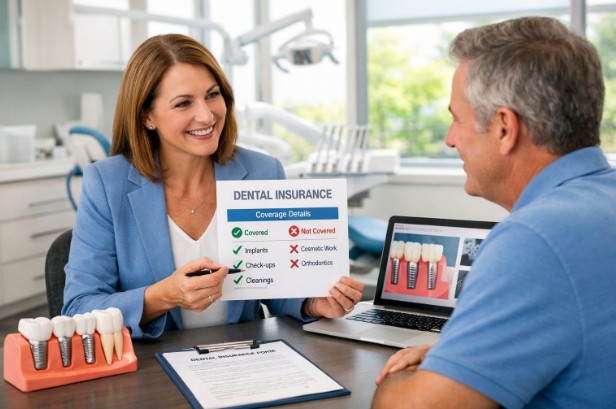
Most dental insurance plans use a standard structure that categorizes treatments. If you know how insurance companies classify procedures, you’ll know what to expect from your PPO coverage.
Your dental implant insurance coverage gets tricky. Most plans classify implants as cosmetic rather than medically necessary, so they usually don’t cover them under standard policies.
Some exceptions do exist. If your dentist can demonstrate that implants are medically necessary due to injury or disease, certain plans may cover a portion.
The best dental insurance for implants typically classifies them as a major procedure, with 50% coverage after you meet your deductible.
Many dental insurance policies for implants include a 6-12-month waiting period before major procedures are covered. Annual maximums still range from $1,000 to $2,000, so they cover only a portion of the total cost.
Your dental PPO plan may offer more flexibility than an HMO when selecting providers who specialize in implants.
| Category | Often covered (varies) | Often limited/excluded |
| Diagnostics | exam, standard X-rays/panorex (plan rules) | advanced imaging, like CT/tomography, may be excluded or separate |
| Surgical | extraction sometimes | Adjunctive surgical/periodontal procedures may be excluded or restricted |
| Implant hardware | — | implant body/post commonly excluded or limited by plan design |
| Restoration | abutment + crown may be covered if a benefit exists | Implant-supported prosthetics vary significantly; documentation is often required |
Even when implants are a covered benefit, your plan’s annual maximum, waiting periods, and any implant-specific cap/lifetime maximum typically determine what you actually pay in Boynton Beach.
Your dental plan’s annual maximum is the most your insurance will pay for covered services in a year. Most plans cap this at $1,000 to $2,000 per year.
Costs vary widely by case (implant type, grafting needs, and restoration), so rely on your written treatment estimate for your exact total.
If implants (or the implant crown/abutment) are covered under your plan’s major benefits, annual maximums can be reached quickly—sometimes within a single tooth replacement.
Here’s how coverage limits shake out for your wallet:
Once you hit your coverage limits, you pay for every bit of dental work for the rest of the year. If you need multiple implants, you might have to split treatment across different years just to use your benefits.
When you get an estimate for dental implants in Boynton Beach, you’ll see CDT codes for insurance claims and billing. These codes spell out each part of your implant procedure.
Common Implant-Related CDT Codes:
| Code | Description | What It Covers |
| D6010 | Surgical placement of the implant body | The actual endosteal implant is placed in your jawbone |
| D6056 | Prefabricated abutment | The connector piece between the implant and the crown |
| D6057 | Custom abutment | A custom-made connector piece |
| D6058-D6067 | Abutment-supported crowns | The visible tooth crown is attached to the abutment |
| D6080 | Implant maintenance procedures | Cleaning and care for your implant |
The D6010 code covers the surgical placement of the implant body—basically, the titanium post that goes into your bone.
Your estimate may also include codes for bone grafts (D7950-D7953) if you need additional support. Subperiosteal implants use their own codes since they sit on top of the bone, not in it.
Proper documentation for each part helps ensure your insurance claim is processed. Your dentist’s office should explain which codes apply to your treatment plan.
If you know these codes, you’ll understand exactly what you’re paying for in your cost breakdown.
Get a written implant cost estimate, then let Boynton Implant and Cosmetic Dentistry coordinate insurance questions and financing choices—Schedule an appointment today.
If you’re ready to get started, call us now!
Most people assume only dental insurance pays for implants. However, your medical insurance may help cover them.
Medical insurance coverage for implants is uncommon and typically requires a trauma- or medically related scenario, along with prior authorization. Confirm coverage in writing before treatment.
When Medical Insurance May Cover Implants:
Coverage is more likely if the procedure is deemed medically necessary for your overall health, not just for looks. For instance, if you lose a tooth in a car accident, your medical insurance may help cover the cost of the implant.
Dental insurance typically treats implants as elective and imposes strict annual coverage limits.
Medical plans generally evaluate whether dental-related services are integral to covered medical care; approval is plan-specific and documentation-driven.
You’ll need to work closely with both your dentist and your doctor to prove medical necessity. Your doctor might have to write a letter explaining how missing teeth affect your ability to eat, speak, or get proper nutrition.
If a medical condition necessitates the implant, such as jawbone deterioration that impacts your health, your medical insurance becomes more relevant.
Contact both your dental and medical insurance providers before you start any treatment. Ask them clear, detailed questions about their coverage rules for dental implants tied to medical issues.
Before you move forward with dental implants, get written answers from your insurance company. Dental insurance verification can help you avoid billing mistakes and surprise costs.
Call your insurance company directly and ask for written documentation. Request details about your specific implant coverage, not just generic info.
Make sure you know whether your in-network dentist offers better rates than out-of-network dentists. It can make a big difference.
Ask for a predetermination of benefits from your insurance company. This document spells out exactly what they’ll pay before you start any treatment.
Your dental office can typically submit this request on your behalf as part of the dental insurance verification process.
Keep copies of all your communications with the insurance company. Save emails, letters, and any claim numbers you get.
Write down the names of anyone you talk to and the date of each conversation. It sounds tedious, but it can save you headaches later.
Many Boynton Beach dental offices accept most major dental plans and can help you figure out your coverage. Some even offer flexible payment plans if your insurance doesn’t cover everything.
If your dental insurance won’t cover implants, don’t panic. You still have a few options to manage the cost.
Many people find relief with payment plans or alternative funding sources.
Your HSA or FSA can help you pay for dental implants using pre-tax dollars. With a health savings account, you set aside money throughout the year.
A flexible spending account works pretty much the same way, but it’s usually through your employer. Both helped you reduce out-of-pocket costs.
CareCredit offers payment plans just for medical and dental expenses. You can split the cost of implants over months or even a few years.
Sometimes, you get a promotional interest-free period, which is a nice bonus. Dental savings plans work differently from insurance.
You pay an annual membership fee and receive discounts—sometimes 10-60%—on dental procedures. These plans start saving you money right away, no waiting or paperwork.
Here are a few other ways to make implants a bit less painful for your wallet:
Some dental offices work with lenders besides CareCredit. You might actually find better terms if you shop around.
Dental discount plans can stack with these options and help reduce the amount you ultimately finance. It’s worth asking your dentist about every possibility.
Not sure your plan covers the implant post, abutment, or crown? Request a benefits check and a pre-treatment estimate—contact Boynton Implant and Cosmetic Dentistry.
Does dental insurance cover implants in Boynton Beach, FL?
Dental insurance may cover implants in Boynton Beach, but coverage varies by plan. Many plans treat parts of implant treatment as “major services,” while others exclude implants or impose restrictions such as annual maximums, waiting periods, or alternative-benefit rules.
What parts of implant treatment are typically covered vs not covered?
When coverage exists, plans more often help with the restoration side (abutment/crown) than the implant post itself. Each step is billed separately, so coverage can differ for diagnostics, surgery, grafting, abutment, and crown—code by code.
What is the annual maximum, and why does it matter for implants?
A dental plan’s annual maximum is the most it will pay in a benefit year. Many plans’ annual maximums are around $1,000–$2,000, so even approved implant-related benefits can quickly cap out, leaving the remainder out-of-pocket.
Do dental insurance plans have waiting periods before implants are covered?
Yes, many plans apply waiting periods before “major” benefits can be used. Major services typically have waiting periods of 6, 12, or 24 months, depending on the insurer and plan type, so timing can affect eligibility for implant coverage.
What is an “alternate benefit” (downgrade), and how does it affect implant coverage?
An alternative benefit (downgrade) means the plan covers the least expensive acceptable treatment, even if you choose implants. For example, it may reimburse as if you received a bridge or partial denture, increasing your out-of-pocket cost.
What is the missing tooth clause, and can it block implant coverage?
The missing tooth clause is a plan rule that can deny coverage for replacing a tooth that was missing before the policy started. If applicable, the plan may deny benefits for implants, bridges, or dentures associated with that tooth.

About Dr. Berglass
Dr. Michael Berglass, a dedicated dentist with over 25 years of experience, specializes in dental implants, cosmetic, and general dentistry in Boynton Beach, Florida. A proud alumnus of Stony Brook School of Dental Medicine (DDS, 1996), Dr. Berglass further honed his expertise with residencies in general practice and dental implants at North Shore-Long Island Jewish Hospital. His journey in dentistry has taken him from New York to North Carolina, and now to Florida, where he continues to offer top-notch dental care. Known for his wit and intellect, Dr. Berglass makes every patient's visit comfortable. A member of the American Dental Association and Florida Dentists' Association, he stays at the forefront of dental advancements. Dr. Berglass is committed to providing exceptional care and looks forward to welcoming you to his practice.
Reason To Smile

Phone
Address
2415 Quantum Blvd
Boynton Beach, FL 3342
Office Hours
Mon - Thurs: 8:30AM-5PM
Fri: 8:30AM-1PM
Sat - Sun: Closed


