
Originally published: January 2026 | Reviewed by Dr. Michael Berglass
How Long After a Tooth Extraction Can You Get an Implant in Boynton Beach, FL: Complete Timeline for Different Clinical Scenarios

Getting a dental implant after losing a tooth is one of the best ways to protect your jaw and restore your smile. The timing, though, matters a lot more than most people realize.
Wait too long, and you risk bone loss that makes surgery tougher. Rushing it may not yield the results you want.
Most patients can receive a dental implant immediately after extraction or within several months. The typical wait is about 8 to 12 weeks, but it really depends on your bone health, infection status, and how fast you heal.
The right timing for you? That depends on why your tooth came out, how much bone you have, and whether you need additional procedures such as grafting. It’s not always a simple answer.
The timeline between tooth extraction and dental implant placement varies a ton from person to person. Knowing which scenario applies to you helps set expectations and gives you the best chance of an implant that actually lasts.
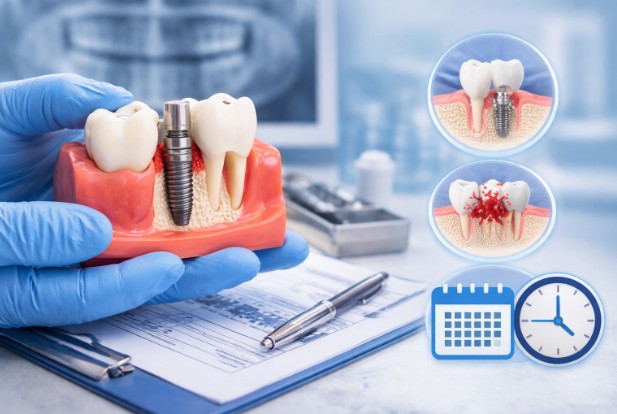
The timing for a dental implant after tooth extraction depends on your specific situation. Some people receive an implant the same day their tooth is removed.
Others need to wait several months before the implant can be placed. Here are the three main timing options:
You can get your dental implant right after extraction if you have healthy bone and no infection. The dentist puts the implant into the empty socket during the same appointment.
You may wait 2 to 8 weeks after extraction before receiving your implant. This gives your gum tissue a little time to heal while preserving most of the bone.
Most patients wait 3 to 6 months after tooth extraction before receiving a dental implant. This is the most common timeline because it allows complete bone healing before implant placement.
The timing of dental implants after extraction is crucial to your long-term success. Waiting too long can lead to bone loss in your jaw, which may require a bone graft before you can receive your implant.
Your dentist will examine your mouth and take X-rays to determine the best timing for you. Factors such as bone density, oral health, and infection status affect when you can receive your implant after extraction.
| Implant timing protocol | Typical timing after extraction | Best-fit scenario | Common reasons to delay |
| Immediate implant placement | Same day (fresh socket) | Clean socket, adequate bone for primary stability | Active infection, inadequate bone/soft tissue, poor stability potential |
| Early placement (soft-tissue healing) | 4–8 weeks | Soft tissue closure needed; reduces some surgical/esthetic risks | Persistent inflammation, uncertain stability, the site needs more healing |
| Early placement (partial bone healing) | 12–16 weeks | Added bone fill and tissue maturation before placement | Significant defects, graft maturation pending, complex anatomy |
| Late placement (complete bone healing) | > 6 months | When substantial healing/augmentation is required | Extensive grafting, complex reconstruction, and higher-risk sites |
If you’re ready to get started, call us now!
The tooth extraction and implant timeline varies based on your specific situation. Here’s what you need to know about when you can get an implant after your tooth is removed:
You can get an implant on the same day as your extraction if you have healthy bone, no infection, and a simple extraction. Your dentist places the implant right into the empty socket during your appointment.
If your gums need time to heal but your bone is healthy, you’ll wait 2 to 8 weeks. This gives soft tissue time to close over the extraction site while bone stays ready for the implant.
Most patients follow the standard implant timeline of 3 to 6 months. This allows the bone to heal after extraction. You’ll need this waiting period if you had an infection, a difficult extraction, or routine healing.
You may need to wait longer than 6 months if you require a bone graft, have a history of infection, or need additional procedures. The bone must heal and regenerate before it can support an implant.
Your specific timing depends on several factors, including bone quality, extraction complexity, and the presence of an infection. Your dentist will check your mouth and recommend the best timeline for your situation.
| Scenario after extraction | Typical implant timing window | What must be true before placement | Notes |
| Clean socket, good bone volume | Same day or 4–8 weeks | Stable bone for primary stability; healthy soft tissue | Often eligible for immediate/early pathways |
| Front tooth with thin facial bone / high esthetic zone | 4–8 weeks or 12–16 weeks | Soft tissue architecture is stable and predictable in positioning | Early protocols are frequently selected to reduce esthetic risk |
| Molar extraction with a large socket | 12–16 weeks or 3–6+ months | Adequate stability; defect managed | Larger sockets often need more site development |
| Active infection/abscess at the extraction site | Usually delayed (often 3–6+ months) | Infection resolved; site debrided/healed | Active infection is a common contraindication to immediate placement |
| History of periodontal disease / inflamed tissues | 12–16 weeks or delayed | Periodontal stability; inflammation controlled | Risk management drives timing |
| Socket preservation graft placed at extraction | Often ~4 months | Graft integration and stable ridge | Literature commonly recommends adequate healing before placement (PMC) |
| Bone graft needed before implant (ridge augmentation) | Often 3–6 months (case-dependent) | Graft maturity confirmed clinically/radiographically | Timing varies by graft type/size/location |
| Sinus lift required (upper posterior) | Often 4–9 months | New bone development is adequate for stability | Some cases allow simultaneous placement if sufficient native bone exists |
Each timing option comes with its own trade-offs. Immediate placement is convenient but only works in ideal cases. Early placement reduces risk and allows you to heal first. Delayed placement is the safest, but it takes the longest.
Early implant placement with soft-tissue healing usually occurs 4-8 weeks after your extraction. This window is getting more popular because it balances speed and safety.
Your soft tissue heals during this period, reducing the risk of infection compared to immediate placement.
The site also stabilizes, so implant surgery is more predictable. Research shows survival rates of 95-100% with fewer complications than immediate placement.
You still avoid the big bone loss that starts after 4 months of waiting. That means your dentist can usually place the implant without extra bone grafting. Plus, you get your permanent crown sooner than with the old-school delayed approach.
Early placement works best when your extraction site needs a little healing, but not a full rebuild.
Need a precise implant-after-extraction timeline? Share your history and imaging, and Boynton Implant and Cosmetic Dentistry will review the same-day graft and healing steps. Contact us.
If you’re ready to get started, call us now!
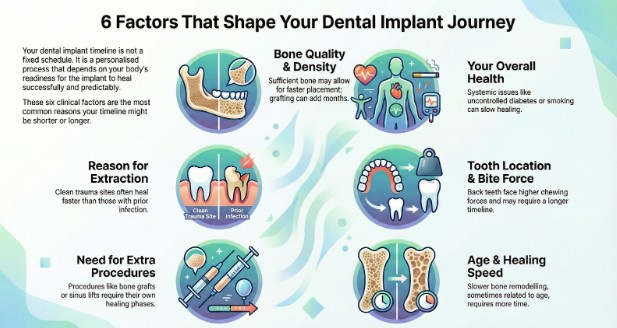
Your implant timing isn’t based on a fixed number of weeks—it’s based on whether your extraction site is stable, infection-free, and ready to hold an implant predictably. These six factors are what most often move the timeline earlier or later.
If you have adequate bone volume and density, you may qualify for immediate or early placement. If the bone is thin or deficient, grafting may be required, which can extend the timeline by several months.
Extractions due to trauma or a clean fracture often allow faster progression. Extractions associated with infection or active inflammation typically require additional healing time before implant placement is considered safe.
Socket preservation, ridge augmentation, and sinus lift procedures can add healing phases before implant placement. The more site development needed, the longer the overall timeline.
Systemic factors such as uncontrolled diabetes, certain autoimmune conditions, and tobacco use can slow healing and increase complication risk, which often leads clinicians to recommend a more conservative timeline.
Front-tooth sites may be candidates for earlier placement in select cases, but esthetic demands can also require careful staging. Back teeth face higher chewing forces and larger sockets, which can delay timing.
Age alone isn’t a disqualifier, but bone turnover and healing speed vary. Your clinician’s goal is stable integration, and slower remodeling may require more time between extraction, grafting, and implant placement.
After your tooth extraction, your body goes through a few healing stages before you’re ready for an implant. Knowing these milestones can help you know what’s coming.
First 24-48 Hours: A blood clot forms in the empty socket. This clot protects the bone and nerves underneath.
Days 3-7: The socket begins to fill with soft tissue. Swelling and discomfort usually drop off during this time.
Weeks 2-4: Your gums begin closing over the extraction site. The bone underneath is starting to heal, but it’s still weak and not ready for an implant yet.
Months 1-3: The alveolar bone changes a lot, and the width can shrink by about 30% in the first three months. That’s why timing matters so much for implants.
Months 3-6: The extraction site fully heals, and the bone gets dense enough to support an implant. Your dentist may suggest placing the implant during this window.
Your healing timeline depends on your age, health, and whether you need bone grafting. Early implant placement at 2-3 months post-extraction can help you avoid the bone loss that happens after tooth removal.
Your dentist will keep an eye on your progress and let you know when you’re ready for the next step.
At Boynton Implant and Cosmetic Dentistry, we don’t pick an implant date based on averages—we choose timing based on whether your extraction site is healthy, stable, and ready to support a predictable result.
We start with a focused clinical exam and a planning workup designed to prevent surprises later. Your assessment typically includes:
We also plan based on where the missing tooth sits:
Your timeline is then finalized based on the factors that most strongly affect implant stability and long-term success:
If the site is clean and the bone conditions are favorable, we may recommend immediate or early placement.
If infection is present, bone is deficient, or additional grafting is needed, we typically recommend a staged approach with a longer healing window to reduce complications and improve predictability.
Ready to replace missing teeth without guesswork? Ask about 3D-guided planning, same-day options, and flexible financing—Schedule an appointment with Boynton Implant and Cosmetic Dentistry.
How long after a tooth extraction can you get an implant?
Implants may be placed the same day, within 4–8 weeks, around 12–16 weeks, or after 3–6+ months. The right window depends on infection control, gum healing, and bone stability, confirmed by exam and imaging.
Can you get a dental implant the same day as an extraction?
Yes—immediate implant placement is possible when the socket is clean, and there’s enough bone for primary stability. If stability or tissue conditions aren’t predictable, early or delayed placement is typically safer.
How long should you wait for an implant after an infected tooth extraction?
If the extraction involved an active infection, clinicians usually wait until the inflammation resolves and the tissues heal. That often shifts you toward a delayed timeline, especially if bone grafting or additional site development is required.
How long after a bone graft can you get a dental implant?
After a bone graft, implants are commonly placed once the graft has integrated and can support stability—typically around 4–6 months, depending on graft size/type and the healing response. Readiness is confirmed clinically and radiographically.
What if I wait months or years after extraction—can I still get an implant?
Yes, implants can often be placed long after an extraction, but bone and gum changes may require additional steps (such as grafting) before placement. Earlier evaluation can preserve options and reduce treatment complexity.
How long does it take from extraction to a final implant crown?
Your timeline has two phases: extraction and implant placement, followed by implant integration before the final crown. Many cases take several months overall; some patients may qualify for same-day temporary teeth as part of a staged plan.
Do I always need a bone graft after a tooth extraction before an implant?
Not always. Grafting may be recommended when socket walls are thin, defects are present, or placement is expected to be delayed. The goal is to preserve ridge volume so the implant can be placed with predictable stability later.

About Dr. Berglass
Dr. Michael Berglass, a dedicated dentist with over 25 years of experience, specializes in dental implants, cosmetic, and general dentistry in Boynton Beach, Florida. A proud alumnus of Stony Brook School of Dental Medicine (DDS, 1996), Dr. Berglass further honed his expertise with residencies in general practice and dental implants at North Shore-Long Island Jewish Hospital. His journey in dentistry has taken him from New York to North Carolina, and now to Florida, where he continues to offer top-notch dental care. Known for his wit and intellect, Dr. Berglass makes every patient's visit comfortable. A member of the American Dental Association and Florida Dentists' Association, he stays at the forefront of dental advancements. Dr. Berglass is committed to providing exceptional care and looks forward to welcoming you to his practice.
Reason To Smile

Phone
Address
2415 Quantum Blvd
Boynton Beach, FL 3342
Office Hours
Mon - Thurs: 8:30AM-5PM
Fri: 8:30AM-1PM
Sat - Sun: Closed


