
Originally published: January 2026 | Updated: May 2026
Reviewed by Dr. Michael Berglass
CBCT Scan for Dental Implants in Boynton Beach, FL: What It Shows and Why It Matters

Getting dental implants is a big decision. Good planning really makes all the difference.
Before your dentist places an implant, they need to see what’s happening below your gum line. That’s where CBCT imaging steps in.
A CBCT scan creates a detailed 3D picture of your jaw. It shows bone thickness, nerve locations, and sinus cavities so your dentist can place implants safely and accurately.
Regular dental X-rays only show flat images. CBCT captures your bone structure and critical anatomical landmarks from every angle.
This technology helps your dentist avoid complications. It gives you a better chance of great results.
If you know what a CBCT scan reveals and why it matters, you’ll probably feel more confident about your implant treatment.
Let’s break down what you need to know about this technology and how it protects your safety during implant placement.
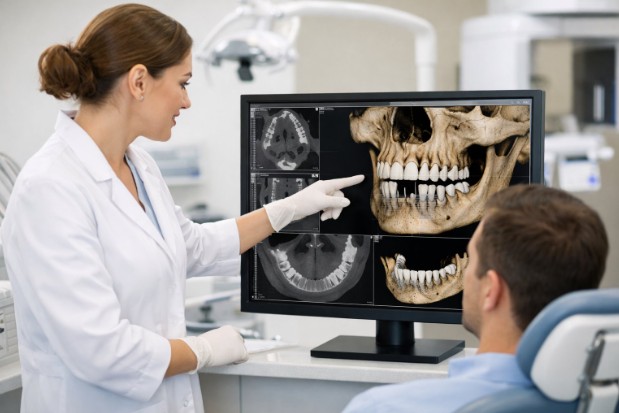
A CBCT scan, or cone-beam computed tomography, is a special type of X-ray equipment that dentists use when standard dental X-rays are insufficient.
Unlike traditional flat dental X-rays, CBCT technology produces 3D scans of your teeth, jawbone, and surrounding structures in a single rotation.
Regular dental X-rays give you two-dimensional images. These flat pictures show your dentist basic info about cavities, tooth roots, and bone levels.
CBCT scans work differently. They capture hundreds of images from multiple angles to build a complete three-dimensional view.
| Feature | CBCT Scan | Regular Dental X-Ray |
| Image Type | 3D | 2D (flat) |
| Detail Level | High precision for bone and soft tissue | Basic overview |
| Scan Time | One rotation (10-40 seconds) | Instant |
| Best For | Implant planning, complex cases | Routine checkups, cavity detection |
Your dentist can obtain precise measurements of bone height, width, and density using cone-beam computed tomography. CBCT scans are optimal for cases requiring 3D imaging of dense structures, such as teeth and the jaw.
This level of detail helps plan dental implant placement with precision. The radiation exposure from CBCT scans stays controlled and safe.
The dosage per scan equals about 2 regular dental X-rays. It’s a reasonable diagnostic tool when your treatment needs detailed imaging.
At Boynton Implant and Cosmetic Dentistry, we use advanced CBCT 3D imaging to plan safer, more precise implants. Schedule your consultation today to see your customized treatment plan.
If you’re ready to get started, call us now!
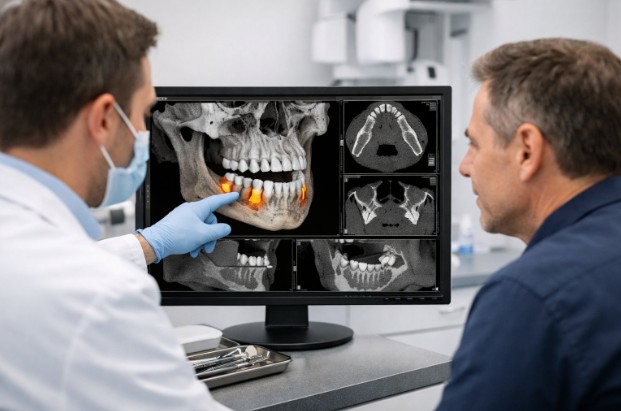
A CBCT scan provides detailed three-dimensional images that help your dentist plan your dental implant procedure with precision. Here are the seven key things your dentist examines:
Your dentist checks how strong and thick your jawbone is. The scan shows bone density and thickness, which help determine whether you have enough support for an implant.
The scan measures the exact height and width of available bone. This helps your dentist determine whether you need a bone graft before placing implants.
Your dentist locates critical structures, such as the inferior alveolar nerve. Visualizing these nerve pathways before surgery reduces the risk of nerve damage during implant placement.
The images reveal any existing bone deterioration. Your dentist can see areas where bone has receded and plan accordingly.
For upper jaw implants, your dentist checks the position and size of your sinus cavities to avoid complications.
The scan shows any impacted teeth, cysts, or infections that might affect implant success. Small cracks or issues that are invisible on standard X-rays become clearly visible.
When you need multiple implants or full-arch restorations, the scan provides accurate measurements for precise implant placement.
This technology has revolutionized implant dentistry by making procedures more predictable and safer.
CBCT scans give your dentist a complete 3D view of your jaw. That really improves the safety and accuracy of dental implant planning.
This technology helps prevent complications. It makes the entire implant placement process more predictable.
When your dentist uses CBCT for dental implant planning, they can design a digital surgical guide before your procedure even starts. The 3D images show the exact location of nerves, sinuses, and blood vessels in your jaw.
This detailed view enables your dentist to determine the ideal angle and depth for each implant. The digital plan transfers to a physical guide that fits over your gums during surgery.
Guided implant planning reduces risks and leads to more predictable outcomes. Your dentist can spot if you need bone grafting before placing the implant.
The precision also results in shorter surgical time and a lower risk of damaging adjacent structures. The surgical guide serves as a template, ensuring your implant goes exactly where it was planned.
That level of accuracy just wasn’t possible with regular X-rays alone. It’s honestly a game-changer for complex cases.
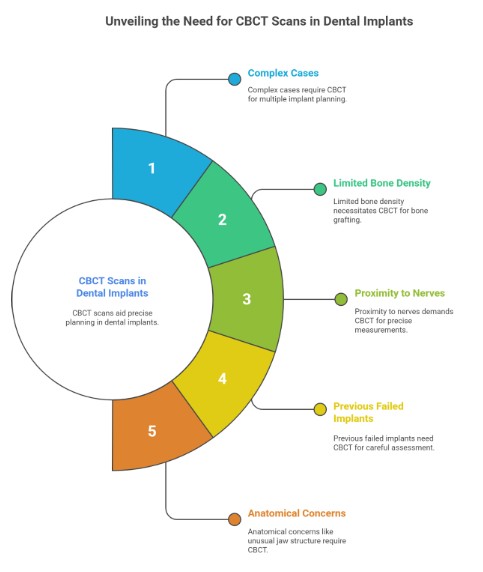
CBCT scans have become essential in modern implant dentistry, but they’re not always required for every case. Knowing when your dentist recommends this imaging helps you know what to expect.
When CBCT Scans Are Recommended:
Your dentist will likely recommend a CBCT scan if you have any of these conditions. The scan ensures precise planning, safety, and long-term success of your implant procedure.
Simple, straightforward implant cases in areas with ample bone might not require CBCT imaging. If you’re getting a single implant up front with no complications, your dentist may stick with standard dental X-rays.
While not always mandatory, CBCT scans provide higher precision and safety. They’re highly recommended for most implant placements.
Your dentist will evaluate your situation and determine the best imaging method. The decision depends on your anatomy, the complexity of your case, and your dentist’s judgment.
It’s always fair to ask your dental provider why they’re recommending a specific scan for your treatment plan. Don’t hesitate to ask questions—it’s your mouth, after all.
Want to know if you need a CBCT scan before dental implants? Our team will explain what it shows and how it enhances safety—Contact us to book your scan.
If you’re ready to get started, call us now!
CBCT scans are generally safe for dental implant planning. CBCT delivers significantly lower radiation than medical CT scans, often delivering doses similar to those of routine dental X-rays taken over multiple visits.
The radiation exposure you get depends on the scan settings your dentist chooses. A smaller field of view means less radiation exposure, since the scan focuses only on the specific area being checked.
Questions to Ask Your Dentist:
Limiting the field of view further reduces the area exposed to radiation, making CBCT even safer. Many CBCT machines are designed for focused scans rather than full-mouth imaging.
Manufacturers continue to develop more efficient scanners that deliver high-quality images at lower radiation doses.
This means CBCT technology keeps getting safer while still providing your dentist with the detailed 3D information needed for precise implant placement.
Your dentist should order a CBCT scan only when the detailed information it provides is truly needed for your treatment.
The benefits of accurate implant planning usually outweigh the minimal radiation risk when the scan is medically justified.
Getting a CBCT scan is quick and painless. The actual scanning part only takes about 20 to 40 seconds. The whole appointment usually wraps up in around 15 minutes, which is honestly pretty convenient.
Before anything starts, you’ll have to remove metal from your head and neck—jewelry, eyeglasses, hearing aids, all of it. Metal tends to degrade image quality, so it’s best to keep it simple.
During the scan, you will:
The CBCT machine resembles a large tube or arm that rotates around your face. You won’t feel a thing. The equipment never touches you, so there’s no discomfort or anything weird.
Your dentist may’ve already taken routine scans of your teeth before this. A CBCT scan provides information beyond standard dental X-rays or intraoral scans because it creates detailed 3D images of your jaw, nerves, and surrounding tissues.
Once the scan ends, you just get back to your day. No recovery time, no fuss. Your dentist will review the images and discuss their findings, either then or at a follow-up appointment.
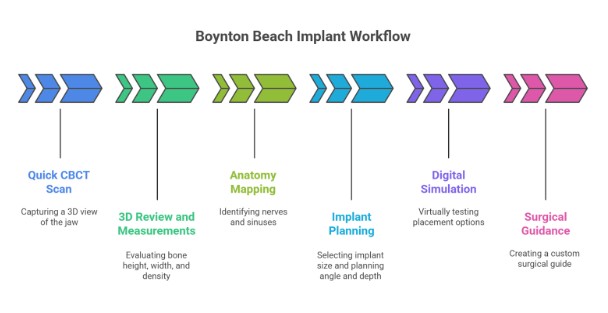
At Boynton Implant and Cosmetic Dentistry, we use CBCT (3D imaging) before implant placement to plan with precision—so we can measure bone, map critical anatomy, and reduce surprises during surgery.
Here’s our typical workflow:
The goal is straightforward: safer planning, more precise placement, and a more predictable long-term result—built around your anatomy, not guesswork.
Ready to plan your implant procedure with confidence? Boynton Implant and Cosmetic Dentistry combines CBCT precision with expert care for long-lasting results. Schedule your appointment now.
What is a CBCT scan for dental implants?
A CBCT scan (cone-beam computed tomography) creates a 3D image of your teeth, bone, and nerves. It lets your dentist plan implant placement with precision, improving safety and long-term success.
Why is CBCT important before getting dental implants?
CBCT scans show bone density, height, and width, as well as the location of nerves and sinuses. This helps your dentist avoid complications and design the most secure implant position.
What does a CBCT scan show that an X-ray doesn’t?
Unlike flat 2D X-rays, CBCT provides three-dimensional views. It reveals bone contours, hidden defects, or sinus issues that standard panoramic or periapical images can miss.
Is a CBCT scan safe?
Yes. A CBCT scan uses a low, focused radiation dose and lasts only seconds. Boynton Implant and Cosmetic Dentistry uses digital protocols that minimize exposure while capturing detailed images.
How long does the CBCT scan take?
Most CBCT scans take less than 1 minute. You simply stand or sit while the machine rotates once around your head, producing a detailed 3D model for your treatment plan.
Do all patients need a CBCT scan before an implant?
Not always. CBCT is recommended when a standard X-ray cannot visualize key anatomy, such as near nerves, sinuses, or thin bone areas, to ensure the safest possible implant placement.
Does insurance cover a CBCT scan for dental implants?
Some dental or medical plans may partially cover CBCT imaging when it’s deemed medically necessary. Our team can verify your benefits and provide a clear estimate before your scan.

About Dr. Berglass
Dr. Michael Berglass, a dedicated dentist with over 25 years of experience, specializes in dental implants, cosmetic, and general dentistry in Boynton Beach, Florida. A proud alumnus of Stony Brook School of Dental Medicine (DDS, 1996), Dr. Berglass further honed his expertise with residencies in general practice and dental implants at North Shore-Long Island Jewish Hospital. His journey in dentistry has taken him from New York to North Carolina, and now to Florida, where he continues to offer top-notch dental care. Known for his wit and intellect, Dr. Berglass makes every patient's visit comfortable. A member of the American Dental Association and Florida Dentists' Association, he stays at the forefront of dental advancements. Dr. Berglass is committed to providing exceptional care and looks forward to welcoming you to his practice.
Reason To Smile

Phone
Address
2415 Quantum Blvd
Boynton Beach, FL 3342
Office Hours
Mon - Thurs: 8:30AM-5PM
Fri: 8:30AM-1PM
Sat - Sun: Closed


