
Originally published: August 2025 | Updated: July 2026
Reviewed by Dr. Michael Berglass
All-on-4 vs Individual Dental Implants: A Comprehensive Guide to Choosing Your Best Tooth Replacement Solution
When you’re faced with the challenge of replacing several missing teeth, you usually end up considering two main options: All-on-4 implants or individual dental implants.
Both have their perks, but determining which one suits your needs requires considering cost, treatment time, bone health, and, ultimately, your lifestyle.
All-on-4 and individual dental implants both restore missing teeth, but they differ in cost, structure, timeline, and ideal patient profile.
All-on-4 is best suited for full-arch replacement, while individual implants are ideal for replacing single or a few missing teeth.
This guide compares both options in detail to help you choose the right solution for your smile.
All-on-4 implants rely on four titanium posts to anchor a full arch of replacement teeth. Individual implants replace each missing tooth with its own posts and crowns.
| Feature | All-on-4 | Individual Implants |
| Number of posts | 4 per arch | 1 per tooth |
| Treatment time | 3-6 months | 6-12 months |
| Bone grafting | Often not needed | May be required |
| Cost for a full mouth | Lower overall | Higher overall |
All-on-4 works well for patients who:
Individual implants suit patients who:
All-on-4 provides quicker results with fewer appointments. Patients often get temporary teeth on the same day.
For individual implants, you’ll need a separate procedure for each tooth. Each one takes about 3-6 months to heal before the dentist can attach the final crown.
The primary difference between dental implants and All-on-4 lies in the number of implants used and the method of restoring missing teeth.
All-on-4 uses four strategically placed implants to support an entire arch. Individual implants step in to replace each missing tooth separately.
All-on-4 dental implants offer a complete tooth replacement solution with just four titanium posts per arch.
Two implants are placed directly into the front of the jaw, while the other two are angled at approximately 30 to 45 degrees to utilize the available bone to its fullest extent.
This technique allows people to receive a full-arch restoration even if they’ve lost some bone. The angled placement helps avoid thinner bone areas or tricky spots like the sinuses.
Key Features of All-On-4:
The prosthetic teeth attach to a metal framework connecting all four implants. This provides a stable base that distributes chewing pressure evenly across your jaw.
Traditional dental implants handle each missing tooth with its own titanium post and crown. The dentist surgically places the post into your jawbone, where it bonds with the bone over a few months.
Each implant acts like a natural tooth root. A connector piece, called an abutment, attaches to the implant, and then a crown is placed on top to complete the job.
Individual Implant Components:
Traditional implants work best if you’ve got good bone density and healthy gums. You need enough bone width and height to support every single post.
The way these options are built affects how they feel and function on a day-to-day basis. Individual implants move and feel like natural teeth, as each one responds independently to biting forces.
All-on-4 systems share the load across four connection points. Chewing with them feels a bit different, and some folks need time to get used to it.
The connected design means that if one implant has issues, it can affect the whole setup. That’s something to keep in mind.
Maintenance Requirements:
Repairs are simpler with individual implants since each tooth stands alone. All-on-4 offers faster treatment, but if something major goes wrong, you might need to replace the entire bridge.
The bone integration process isn’t quite the same for both. Individual implants fuse with the bone one by one, whereas All-on-4 implants rely on all four posts working together for stability.
Not sure which dental implant option fits your needs? Book a consultation with Dr. Berglass at Boynton Implant and Cosmetic Dentistry and get a personalized treatment plan today.
If you’re ready to get started, call us now!
The surgical techniques for All-on-4 and individual implants differ significantly. Individual implants require precise placement for each tooth, but All-on-4 achieves this with four angled implants that support an entire arch.
With individual implants, the dentist creates a separate surgical site for every missing tooth. They drill into your jawbone exactly where your tooth root used to be.
Each implant requires its own healing period before you receive the crown, which may result in multiple appointments spread out over several months.
All-on-4 dental implants use just four strategically placed implants to support an entire arch. Two go vertically in the front, and two are angled in the back for extra stability.
The angled placement lets the implants anchor into stronger bone. Often, you can walk out with temporary teeth the same day as surgery.
Key Placement Differences:
Individual implants often require bone grafting if your jawbone has shrunk in certain areas. Each implant needs enough bone at its exact location.
If you’re missing several teeth, you may need a few bone grafts, which can add months to your treatment timeline.
All-on-4 typically eliminates most grafting, thanks to its angled implant design. This approach allows dentists to utilize the existing bone and avoid areas with significant bone loss.
Strategic placement often means you don’t need sinus lifts in the upper jaw. All-on-4 can work even for people who thought they didn’t have enough bone for regular implants.
Individual implants use separate crowns for each tooth. Each crown attaches to its own abutment, which screws into the implant under your gums.
This setup makes it easy to maintain and swap out parts. If a crown breaks, you can simply replace that one without affecting the rest.
All-on-4 implants support a complete bridge that covers all the teeth in the arch. The bridge has 10-14 artificial teeth connected as a single unit.
The bridge screws onto the four implants through little access holes. After attachment, the dentist seals the holes so it looks seamless.
Component Comparison:
| Feature | Individual Implants | All-on-4 |
| Restoration Type | Individual crowns | Full arch bridge |
| Number of Pieces | One per tooth | Single connected unit |
| Repairability | Individual components | Entire bridge replacement |
Most dentists use local anesthesia for single-tooth implant surgeries. If you need several implants in one visit, you might get IV sedation instead.
Surgery time jumps around. One implant can take just 30 minutes, but several might stretch into hours.
Usually, patients can get 2-3 implants in a single appointment. That’s manageable for most people.
All-on-4 surgeries almost always call for IV sedation. They’re longer and more complex, often running 2-4 hours per arch, especially if extractions are involved.
Most folks get their upper and lower arches done in separate visits. Splitting it up helps with healing and keeps the whole thing from being overwhelming.
Each individual implant undergoes osseointegration on its own over 3-6 months—the jawbone bonds to the implant before you get your permanent crown.
Healing speeds vary depending on the location of the implant in your mouth. Front teeth usually heal up faster than molars because the bone is a bit different.
All-on-4 implants also need time to integrate with your bone. The bridge connecting them keeps things stable while you heal, which tends to make the process more predictable.
With All-on-4, you get a temporary bridge right after surgery. That immediate loading actually encourages bone growth around all four implants at once.
After about 3-4 months, you’ll swap the temporary bridge out for a permanent one. It’s a pretty streamlined process compared to the old way of doing things.
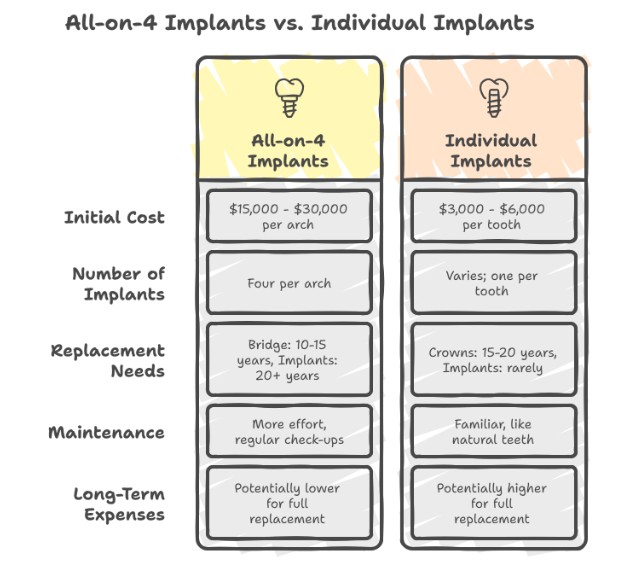
All-on-4 implants offer a more upfront cost, but you require fewer implants than if you replaced each tooth individually.
Over the years, costs fluctuate depending on the frequency of maintenance and whether you require repairs or replacements.
All-on-4 usually runs $15,000 to $30,000 for each arch. That covers four implants and the full bridge they support.
Individual implants cost between $3,000 and $6,000 per tooth. That includes the implant itself, the abutment, and the crown.
Cost comparison for full mouth restoration:
If you need to replace multiple teeth, All-on-4 offers a more cost-effective solution. For just one or two missing teeth, individual implants are often the most sensible option.
The All-on-4 system works with only four implants per arch. Traditional methods often use 5-8, so you save on surgical time and materials.
All-on-4 bridges usually last 10-15 years before needing replacement. The implants themselves can last over 20 years if proper care is taken.
Individual implants rarely need replacing, but their crowns might wear out after 15-20 years. It depends on how well you care for your teeth.
Maintenance costs include:
All-on-4 patients deal with a bit more maintenance. Cleaning the full bridge requires extra effort, and regular check-ups are necessary.
Individual implants act like natural teeth, so daily care feels familiar. If one has an issue, it usually doesn’t affect the others.
Long-term expenses for All-on-4 are often lower if you’re replacing a whole mouthful of teeth. Fewer surgery sites mean less hassle and fewer follow-ups.
Most dental insurance pays for 10-50% of implant costs. The coverage details can vary significantly between All-on-4 and individual implants.
Individual implants typically receive better insurance coverage. Carriers often view them as necessary, whereas All-on-4 is generally considered a cosmetic procedure.
Popular financing options include:
Some patients use medical financing for All-on-4 because it’s a more extensive and comprehensive procedure. Health savings accounts (HSAs) can help cover costs, too.
Monthly payments typically range from $200 to $800, depending on your total bill and the plan you select.
All-on-4 average costs by region:
| Type / Location | Average Cost |
| All-on-4 (Urban areas) | $20,000 – $35,000 per arch |
| All-on-4 (Suburban areas) | $15,000 – $25,000 per arch |
| All-on-4 (Rural areas) | $12,000 – $20,000 per arch |
| Individual Implant (Premium location) | $4,000 – $7,000 per tooth |
| Individual Implant (Standard practice) | $3,000 – $5,000 per tooth |
| Individual Implant (Budget provider) | $2,000 – $4,000 per tooth |
Where you live affects the price. Big cities usually charge 20-40% more than smaller towns.
The upfront cost may seem high, but the long-term benefits often justify the investment for individuals who require extensive tooth replacement. Surgeon experience and office overhead also bump up the final price tag.
Typical payment breakdowns:
Choosing between All-on-4 and individual implants is easier with expert advice. Contact Boynton Implant and Cosmetic Dentistry now to explore the best long-term option for your smile.
If you’re ready to get started, call us now!
All-on-4 implants expedite the process—sometimes in a single day. Individual implants take months, with healing breaks between each step.
Individual implants roll out in stages over 3-6 months. First, you get the implant in your jaw, then you wait 3-4 months for the bone to fuse with it.
Once that heals, you come back for the abutment. That takes another couple of weeks to settle before the final crown goes on.
All-on-4 moves much faster than the traditional route. You get a whole arch of teeth on the same day the implants are placed.
Permanent bridges usually come 3-4 months later. No drawn-out healing between steps—just two main stages.
The All-on-4 dental implant procedure offers a more efficient treatment timeline. You walk in for surgery and leave with working teeth that day.
Implants, impressions, and temporary crowns happen all in one go. The process cuts down on appointments—usually just two big ones.
Individual implants need a separate visit for each tooth. If you’re replacing four teeth, that’s multiple surgeries and recovery periods.
With the staged approach, you may experience gaps in your smile for months. That can significantly impact your confidence and daily life.
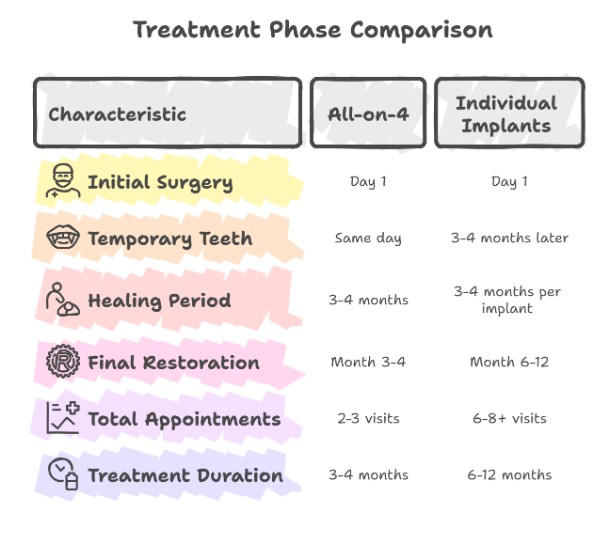
All-on-4 patients typically return 2-3 times after the initial procedure. The first check occurs within a week, followed by another at 2-3 months for the permanent bridge.
Individual implants mean 6-8 appointments, sometimes more. Each tooth needs its own surgery, healing check, abutment, and crown fitting.
All-on-4 gives you one main recovery, usually 7-10 days. Individual implants mean multiple recoveries, each lasting a week or two.
All those appointments can be a headache if you’ve got a busy schedule. Traditional implants often mean more time off work and more disruption.
| Treatment Phase | All-on-4 | Individual Implants |
| Initial Surgery | Day 1 | Day 1 |
| Temporary Teeth | Same day | 3-4 months later |
| Healing Period | 3-4 months | 3-4 months per implant |
| Final Restoration | Month 3-4 | Month 6-12 |
| Total Appointments | 2-3 visits | 6-8+ visits |
| Treatment Duration | 3-4 months | 6-12 months |
Key Timeline Advantages:
The timeline really highlights how much faster All-on-4 can be. Individual implants are suitable for those who want to take things slowly or prefer smaller procedures spaced out.
Your bone health, age, and the number of teeth you’re missing all factor into which implant option is best suited for you. Budget and lifestyle matter too, honestly.
Bone density is the most crucial factor when selecting between implant types. All-on-4 works well if you’ve lost some bone, since it uses longer implants at angles to avoid weak spots.
Individual implants require solid bone in every location where you want a tooth. If your jawbone’s in good shape, you can pick either. If not, you might need a bone graft before you can get individual implants.
Age changes healing speed, but it doesn’t rule you out. Older adults often prefer All-on-4 because it requires fewer surgeries. Younger people sometimes go for individual implants since they’ll last a long time.
The number of missing teeth makes the choice clearer:
If you’re missing nearly a whole arch, you’re probably an ideal candidate for All-on-4. If tooth loss is scattered, individual implants fit better.
Budget constraints usually shape the final decision. All-on-4 costs less upfront than replacing many individual teeth.
All-on-4 implants can start as low as $350 per month with financing. Individual implants cost more when you need to replace several teeth, but you can do them one at a time to spread out the expense.
Oral hygiene habits really matter for both options. Individual implants require careful cleaning around each post, whereas All-on-4 prosthetics necessitate the use of special cleaning tools and techniques.
If you struggle with daily oral care, All-on-4 may be a more convenient option. The fixed bridge is just simpler to clean than juggling several crowns.
Time availability can also tip the scales. All-on-4 gives you immediate results in a single day, while individual implants take months between surgeries and final restoration.
Individuals with busy schedules who cannot afford to take much time off work often opt for the faster All-on-4 approach.
Some conditions make one option impossible but leave the other open. Severe bone loss in certain areas might rule out individual implants, yet still allow All-on-4 placement.
Active gum disease needs treatment before any implant surgery. If your oral health isn’t up to par, you’ll need to improve it first.
Uncontrolled diabetes affects healing and may disqualify you from longer procedures. All-on-4 sometimes works better since it involves fewer surgical sites.
Heavy smoking lowers success rates for both treatments. Still, All-on-4 may have slightly better odds because of the cross-arch stabilization.
Insufficient bone width in the front jaw can rule out All-on-4. Individual implants may still be viable where sufficient bone remains.
If you take medications like bisphosphonates, your dentist will need to evaluate you carefully. These meds affect bone healing differently depending on the procedure.
Ask yourself these questions to get a sense of which option fits you best:
About your missing teeth:
About your oral health:
About your preferences:
About your lifestyle:
Candidacy is determined on an individual basis through professional evaluation. These questions just help you prep for a real conversation with your dentist.
If you have good bone density and are willing to undergo multiple surgeries, individual implants may be a suitable option for you.
If you want fast results and have a lot of missing teeth, the All-on-4 treatment is often the go-to option.
If you’re ready to get started, call us now!
Both dental restoration options have their own advantages and disadvantages. All-on-4 provides faster results with fewer appointments, while individual implants preserve more of your natural tooth structure.
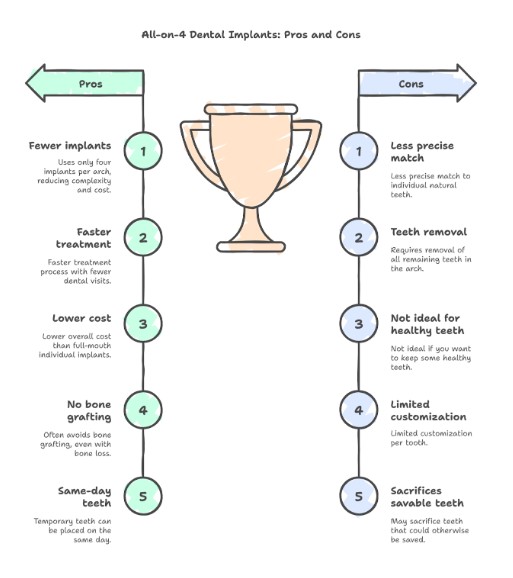
| Advantages | Disadvantages |
| Uses only four implants per arch | Less precise match to individual natural teeth |
| Faster treatment process with fewer dental visits | Requires removal of all remaining teeth in the arch |
| Lower overall cost than full-mouth individual implants | Not ideal if you want to keep some healthy teeth |
| Often avoids bone grafting, even with bone loss | Limited customization per tooth |
| Temporary teeth can be placed on the same day | May sacrifice teeth that could otherwise be saved |
| Advantages | Disadvantages |
| Preserves natural tooth structure whenever possible | Higher total cost for replacing multiple teeth |
| Offers a better aesthetic match, especially for front teeth | Longer treatment timeline with various procedures |
| Allows for targeted, selective tooth replacement | Often requires more bone grafting for support |
| Easier cleaning and flossing, like natural teeth | More appointments are needed for planning, placement, and crowns |
Stability and Comfort: All-on-4 systems give solid stability through strategic implant placement. The four implants help spread chewing forces evenly across your arch.
Individual implants provide a natural biting sensation, as each tooth receives its own root support.
Most people experience less initial discomfort with All-on-4 because there are fewer surgical sites involved. Individual implants can cause more short-term soreness, but each one heals on its own.
Aesthetic Results: Individual implants typically excel in terms of front-tooth aesthetics. Each crown can closely match your natural teeth. All-on-4 creates a uniform look, which sometimes doesn’t look quite as real.
Daily Maintenance: All-on-4 implants require specialized cleaning tools, such as water flossers and unique brushes.
Individual implants clean up just like regular teeth with brushing and flossing. Both options require regular dental checkups and professional cleanings.
| Category | All-on-4 | Individual Implants |
| Limitations | Not suitable for severe bone loss or advanced gum disease | May require complex planning for multiple missing teeth |
| Less flexibility for future adjustments | Less practical for full-arch restoration | |
| Failure of one implant can affect the entire arch. | ||
| Risks | Possible implant failure if post-op care isn’t followed | Bone grafting is often required |
| May require revision if major bite issues develop | Longer healing phases between procedures | |
| Expectations | Temporary teeth are usually placed on the same day | Final crown placement takes 3–6 months |
| Requires strict oral hygiene and regular checkups | Also requires excellent oral hygiene and follow-up care | |
| Smoking and some health conditions can impair healing | Smoking and certain medical issues affect healing outcomes | |
| Recovery Timeline | 1–2 weeks of initial healing; function returns quickly | Each implant requires separate healing; total timeline 3–6+ months |
All-on-4 Works Best For:
Individual Implants Are Better For:
Decision factors include age, overall health, and bone quality, all of which play a role. A budget often pushes people toward All-on-4 for larger restorations. Your lifestyle and the importance you place on aesthetics also matter.
Dental professionals assess individual circumstances, such as bone health and patient goals. The best choice depends on your specific needs and oral health.
All-on-4 shines for patients with extensive tooth loss or failing dentures. Individual implants work better if you’re missing only a few teeth. The right decision depends on your bone health, budget, and long-term goals.
All-on-4 really comes into its own when you’ve lost most or all teeth in an arch. This often follows years of gum disease, decay, or even trauma.
If you’re tired of traditional dentures that slip or irritate, All-on-4 can provide immediate stability. It’s a relief for anyone who struggles with eating or feels embarrassed in social settings.
When a bridge fails due to several teeth underneath going bad, All-on-4 often makes more sense than fixing each tooth individually.
Ideal candidates include:
Your age matters less than your overall health and bone structure. Many people in their 60s or 70s opt for All-on-4, provided their health is stable.
Individual implants are impractical for replacing most teeth in an arch. Placing 10-14 implants takes way more time, money, and surgery than All-on-4’s four-implant method.
People with severe bone loss have a tough time with individual implants, since each post needs solid bone support. That often means extra grafting surgeries.
Situations favoring All-on-4 over individual implants:
Individual implants can be overwhelming to maintain, especially if you’re not up for detailed cleaning routines. Each post needs separate care and attention.
The emotional side matters, too. If you’re facing extensive tooth loss, All-on-4’s comprehensive approach often feels less daunting than undergoing replacements over months or years.
Certain conditions can make All-on-4 a risky or even unfavorable option. Heavy smokers, especially, run into trouble here—nicotine just chokes off the blood flow that implants need to heal and fuse properly.
Medical contraindications include:
Insufficient bone volume in specific areas can also get in the way. Although All-on-4 works with less bone than individual implants, a certain minimum is still required.
If you expect instant, flawless results, you might want to pause. The first set of teeth can take some getting used to, and the final version takes several months to adjust to.
Financial red flags:
Bruxism—teeth grinding—needs a careful look. If you grind your teeth hard, you can crack the prosthetics or stress the implants way too much.
Anyone under 25 should usually wait, unless there’s been some kind of trauma. The jawbone keeps developing into your mid-twenties, so jumping in too soon could mess with long-term stability.
Honestly, many patients only gain clarity after weighing the factors that matter most to them. Seeing diagnostic images that show exactly how each option would look makes a huge difference.
Patients typically focus on three key aspects. Budget is often the dealbreaker—individual implants cost more up front, but might last longer overall.
Timeline is another biggie. If you need teeth fast for a big event or work, All-on-4’s same-day teeth option is hard to beat.
Bone health often decides what’s possible. If you’ve lost a lot of bone, All-on-4 usually wins since it doesn’t require as much bone as individual implants.
The number of missing teeth also plays a role. Folks missing all or most teeth in an arch lean toward All-on-4, but if you’ve just got a few gaps, individual implants might make more sense.
Lifestyle factors sneak in as well. If you’re extremely active and want the strongest bite, individual implants may be a better option. If you want less hassle, All-on-4’s easier maintenance is a draw.
The best way to determine which option suits your needs is to meet with an experienced implant dentist. They can take a close look at your bone density, gum health, and other factors that matter for treatment success.
Personalized treatment plans address your specific concerns and goals—things you can’t sort out with online research. Everyone’s jaw, bite, and lifestyle are a little different, so you need that individual assessment.
Free consultations cut out the guesswork. You get a clear timeline and an exact cost breakdown.
During your visit, they’ll use advanced imaging tech to show you exactly how each option would work. Sometimes, seeing those images is what finally helps people make a decision.
If you schedule a consultation, you’ll also get info on financing and payment plans. That can make treatment more affordable, regardless of which route you ultimately choose.
You deserve clarity and confidence. Schedule your implant consultation with Dr. Berglass at Boynton Implant and Cosmetic Dentistry and take the next step toward a permanent, healthy smile.
What’s the difference between All-on-4 and individual implants?
All-on-4 uses four implants to support a full arch of teeth, while individual implants replace each missing tooth with its own post and crown.
Which is more affordable—All-on-4 or individual implants?
For full-arch restoration, All-on-4 is usually more cost-effective. Individual implants can be more expensive when replacing multiple teeth, but may be cheaper for just one or two.
Does All-on-4 require bone grafting?
Often, no. All-on-4 is designed to avoid bone grafting by placing implants at strategic angles, even in patients with some bone loss.
How long does it take to recover from each option?
All-on-4 patients often receive temporary teeth on the same day, with full healing occurring within 3–6 months. Individual implants require 3–6 months per implant before crowns are added.
Can I keep my natural teeth with the All-on-4 treatment?
No. All-on-4 requires the removal of all teeth in the arch being restored. Individual implants allow you to keep healthy neighboring teeth.
Are individual implants more natural-looking?
Yes. Individual implants typically offer a closer match to your natural teeth, especially in the front of the mouth.
Which is better for front teeth—All-on-4 or single implants?
Individual implants offer better aesthetics for front teeth. All-on-4 is usually used for full-arch restoration and may not match the precision of individual front-tooth implants.
What are the main risks of All-on-4?
If one implant fails, it may compromise the whole arch. Also, future adjustments are limited compared to individual implants.

About Dr. Berglass
Dr. Michael Berglass, a dedicated dentist with over 25 years of experience, specializes in dental implants, cosmetic, and general dentistry in Boynton Beach, Florida. A proud alumnus of Stony Brook School of Dental Medicine (DDS, 1996), Dr. Berglass further honed his expertise with residencies in general practice and dental implants at North Shore-Long Island Jewish Hospital. His journey in dentistry has taken him from New York to North Carolina, and now to Florida, where he continues to offer top-notch dental care. Known for his wit and intellect, Dr. Berglass makes every patient's visit comfortable. A member of the American Dental Association and Florida Dentists' Association, he stays at the forefront of dental advancements. Dr. Berglass is committed to providing exceptional care and looks forward to welcoming you to his practice.
Reason To Smile

Phone
Address
2415 Quantum Blvd
Boynton Beach, FL 3342
Office Hours
Mon - Thurs: 8:30AM-5PM
Fri: 8:30AM-1PM
Sat - Sun: Closed


