
Originally published: March 2025 | Updated: August 2026
Reviewed by Dr. Michael Berglass
Abscessed Tooth Treatment Checklist: A Step-by-Step Guide to Managing and Recovering from a Dental Abscess

A dental abscess is a bacterial infection that forms a pus pocket at a tooth’s root or in the gum, and requires professional treatment — never home remedies alone.
Dr. Michael Berglass, DDS, of Boynton Implant and Cosmetic Dentistry treats abscesses with drainage, root canal therapy, or extraction, and antibiotics when the infection has spread beyond the tooth.
Left untreated, an abscess can progress to sepsis or Ludwig’s angina, so patients with swelling, fever, or throbbing pain should promptly schedule same-day emergency dental care.
Throbbing tooth pain and persistent facial swelling signal a bacterial infection that needs same-day professional attention — Dr. Berglass offers emergency abscess treatment at the practice.
A dental abscess is a localized pocket of pus caused by a bacterial infection inside a tooth or in the gum tissue surrounding it. Two types are recognized: a periapical abscess forms at the tip of the tooth’s root, and a periodontal abscess develops in the gum pocket beside a tooth root.
According to the Mayo Clinic, untreated tooth decay and gum disease cause most abscesses. Bacteria travel through the damaged tooth structure or gum pocket, infect the soft pulp or supporting tissue, and produce swelling, pressure, and pain as pus accumulates.
A periapical abscess starts inside the tooth, usually from untreated decay that reaches the nerve.
A periodontal abscess starts in the gum tissue, usually from advanced gum disease or trapped debris in a deep pocket. Both types require professional drainage; neither resolves through home care alone.
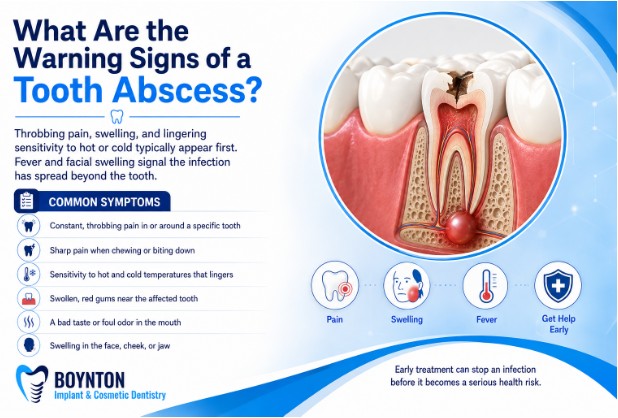
Throbbing pain, swelling, and lingering sensitivity to hot or cold typically appear first. Fever and facial swelling signal the infection has spread beyond the tooth.
Fever above 101°F (38.3°C), difficulty breathing or swallowing, and swelling that spreads toward the eye or neck indicate the infection has moved beyond the tooth.
These symptoms require immediate dental attention rather than a scheduled appointment, since a spreading infection, per the American Dental Association, can progress to sepsis or Ludwig’s angina within hours.
If you’re ready to get started, call us now!
Treatment always starts with resolving the infection, not simply masking pain. Drainage, root canal therapy, or extraction removes the source of the bacteria.
Dr. Berglass first examines the tooth and takes an X-ray to determine how far the infection has spread and whether the tooth can be saved.
The dentist may prescribe antibiotics before or after the procedure when infection extends beyond the tooth itself. Patients considering root canal therapy to save the tooth can expect the diseased pulp removed and the canal sealed in a single visit.
| Treatment | When It’s Used | What It Involves |
| Abscess drainage | Pus pocket with the tooth structure still intact | A small incision releases the pus, often paired with antibiotics |
| Root canal therapy | Infection confined to the tooth’s pulp | Diseased pulp removed, canal cleaned and sealed to save the tooth |
| Tooth extraction | Tooth too damaged or infected to save | Tooth removed and the abscess drained in the same visit |
Following the dentist’s post-treatment instructions, including completing the full antibiotic course, determines how well the infection clears and whether the tooth can be preserved.
A warm saltwater rinse and an over-the-counter pain reliever can manage discomfort until a dentist can examine the tooth, but neither substitutes for professional drainage.
These steps manage symptoms only. The infection itself requires professional emergency pain relief and treatment to fully resolve.
Home remedies only mask abscess pain temporarily — Dr. Berglass provides same-day drainage and treatment; schedule an appointment at the practice.
Swelling and tenderness typically peak within the first day or two after treatment, then ease steadily as the antibiotic course progresses and healing progresses.
| Recovery Stage | Typical Timeframe | What to Expect |
| Initial healing | Shortly after treatment | Swelling and tenderness are at their highest; pain relievers manage discomfort |
| Early recovery | In the days that follow | Swelling recedes steadily; the antibiotic course continues if prescribed |
| Full recovery | In the following weeks | Gum tissue heals completely; a follow-up visit confirms the infection has cleared |
Staying hydrated, resting with the head slightly elevated, and continuing warm salt water rinses two to three times a day, according to University of Michigan Health post-operative guidance, support healing. Soft, lukewarm foods reduce irritation to the treated area during the first several days.
Worsening pain after two to three days, a fever above 101°F, or new numbness in the jaw all warrant a call back to the dental office rather than waiting for the next scheduled visit.
If you’re ready to get started, call us now!
Consistent oral hygiene and regular dental checkups catch decay and gum disease before either progresses into an abscess.
A diet high in sugar feeds the bacteria responsible for decay, and smoking, per the National Institute of Dental and Craniofacial Research, weakens the immune response needed to fight infection.
Diabetes and other conditions that affect immune function also increase abscess risk, making routine gum disease management especially important before decay advances.
Tooth pain doesn’t wait for a convenient time — Dr. Berglass and the team at the practice provide same-day abscess treatment; call now for urgent care in Boynton Beach.
What is a dental abscess?
A bacterial infection causes a dental abscess, producing a pocket of pus at the root of a tooth or in the surrounding gum tissue, along with throbbing pain, swelling, and sensitivity. Professional drainage, root canal therapy, or extraction resolves the infection; home treatment alone does not.
What does an abscessed tooth feel like?
Most patients describe a constant, throbbing ache that worsens with biting, along with sensitivity to hot and cold that lingers after the trigger is removed. Swollen gums, a bad taste, and facial swelling often accompany the pain as the infection progresses.
Can a tooth abscess heal without antibiotics?
Antibiotics control the spread of infection but do not eliminate the abscess itself. Drainage, root canal therapy, or extraction removes the source of the infection; without one of these procedures, the abscess typically persists or recurs even after antibiotics are finished.
How long does it take an abscessed tooth to heal after treatment?
Swelling and tenderness typically ease within the first week after drainage or root canal therapy, while complete healing of the surrounding tissue continues for several weeks. A follow-up appointment confirms the infection has fully cleared and the treated tooth is healing properly.
What happens if a tooth abscess is left untreated?
An untreated abscess can spread infection to the jawbone, neighboring teeth, or bloodstream, leading to sepsis, a life-threatening blood infection, or Ludwig’s angina, a serious neck infection that can obstruct breathing. Prompt treatment prevents these complications and typically saves the affected tooth.
Is it safe to use ice or heat on a swollen jaw from an abscess?
A cold compress applied to the cheek near the swollen area for 15 minutes at a time can safely reduce swelling and help numb the discomfort. Heat is not recommended, since it can increase blood flow to the infected area and worsen swelling.
Can clove oil relieve abscess pain?
Clove oil’s natural numbing properties can dull pain temporarily when dabbed on the sore area with a cotton swab. Clove oil does not treat the underlying infection, so professional drainage or root canal therapy is still required to resolve the abscess itself.
What are the signs a tooth abscess is spreading?
Facial swelling that extends toward the eye or neck, a fever above 101°F, difficulty swallowing or breathing, and persistent numbness in the jaw all indicate the infection has spread beyond the tooth. These symptoms require same-day emergency dental care.
Will a tooth with an abscess always need to be extracted?
Most abscessed teeth are saved through root canal therapy, which removes the infected pulp and seals the tooth. Extraction becomes necessary only when the tooth structure is too damaged, or the infection has destroyed too much supporting bone to save it.

About Dr. Berglass
Dr. Michael Berglass, a dedicated dentist with over 25 years of experience, specializes in dental implants, cosmetic, and general dentistry in Boynton Beach, Florida. A proud alumnus of Stony Brook School of Dental Medicine (DDS, 1996), Dr. Berglass further honed his expertise with residencies in general practice and dental implants at North Shore-Long Island Jewish Hospital. His journey in dentistry has taken him from New York to North Carolina, and now to Florida, where he continues to offer top-notch dental care. Known for his wit and intellect, Dr. Berglass makes every patient's visit comfortable. A member of the American Dental Association and Florida Dentists' Association, he stays at the forefront of dental advancements. Dr. Berglass is committed to providing exceptional care and looks forward to welcoming you to his practice.
Reason To Smile

Phone
Address
2415 Quantum Blvd
Boynton Beach, FL 3342
Office Hours
Mon - Thurs: 8:30AM-5PM
Fri: 8:30AM-1PM
Sat - Sun: Closed


