
Originally published: October 2024 | Updated: August 2026
Reviewed by Dr. Michael Berglass
Dental Implants for Seniors: Age, Bone Density, and Implants vs. Dentures in Palm Beach County

Age alone doesn’t disqualify anyone from dental implants — overall health and jawbone density are among the main factors that determine candidacy.
Boynton Implant and Cosmetic Dentistry evaluates Palm Beach County seniors using CBCT imaging rather than age cutoffs, since a systematic review of implant patients aged 65 and older found survival rates of 98% at 1 year and 91% at 10 years.
Palm Beach County seniors wondering whether their bone density supports implants can request a free consultation and CBCT evaluation with Dr. Berglass.
Age itself isn’t a barrier to dental implants — health status, bone density, and healing capacity matter far more than a patient’s age.
A systematic review comparing implant survival between patients in 65–75 and older cohorts found no significant difference in success rates, concluding implants remain a reliable treatment for older adults, including those over 75.
That same review notes decreased bone density and a higher prevalence of systemic conditions can still elevate risk in some older patients, which is why evaluation stays individualized rather than age-based.
Several considerations do get extra attention during evaluation for senior patients:
Bone density directly determines whether an implant can be placed without additional preparation, and it can decline with age for reasons distinct from tooth loss alone.
According to the National Institute on Aging, osteoporosis causes bone to break down faster than the body rebuilds it, and this same process can affect the jawbone as it does other bones in the body.
The American Academy of Implant Dentistry notes in its guidance on osteoporosis that patients with the condition can still receive successful implants. However, those on certain bisphosphonate medications should discuss their history with their dentist beforehand, since that class of medication carries its own considerations for jaw surgery.
Bone loss from missing teeth compounds this age-related decline, since the jawbone that once supported a tooth root can begin to shrink once that pressure is gone.
When a CBCT scan shows insufficient density, bone grafting can rebuild the site before an implant is placed — this is common enough in older patients that it’s a routine part of treatment planning rather than an obstacle.
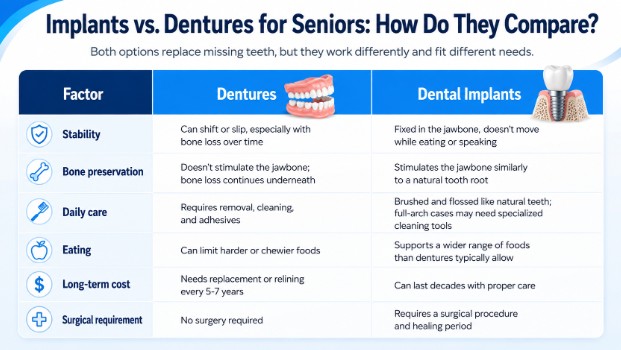
Implants and dentures solve the same problem — missing teeth — through very different mechanisms, and each has situations where it fits better than the other.
| Factor | Dentures | Dental Implants |
| Stability | Can shift or slip, especially with bone loss over time | Fixed in the jawbone, doesn’t move while eating or speaking |
| Bone preservation | Doesn’t stimulate the jawbone; bone loss continues underneath | Stimulates the jawbone similarly to a natural tooth root |
| Daily care | Requires removal, cleaning, and adhesives | Brushed and flossed like natural teeth, though full-arch restorations may need specialized cleaning tools |
| Eating | Can limit harder or chewier foods | Supports a wider range of foods than dentures typically allow |
| Long-term cost | Needs replacement or relining every 5–7 years (ADA) | Can last decades with proper care |
| Surgical requirement | No surgery required | Requires a surgical procedure and healing period |
Implants aren’t automatically the better choice for every senior. Dentures may remain the more appropriate option for patients who aren’t candidates for surgery, have health conditions that make oral surgery higher-risk, prefer a non-surgical solution, or have budget constraints that make the implant timeline impractical.
The right choice depends on individual anatomy, health status, and personal preference — which is exactly what a CBCT evaluation and consultation are meant to sort out rather than assume in advance.
Palm Beach County has one of the largest senior populations in Florida, with about 26.1% of residents 65 or older according to Census data — well above the national figure.
That means local dental practices see a high volume of senior implant cases, and Boynton Implant and Cosmetic Dentistry treats patients from across the county at its Boynton Beach office. Seniors researching implants locally should know:
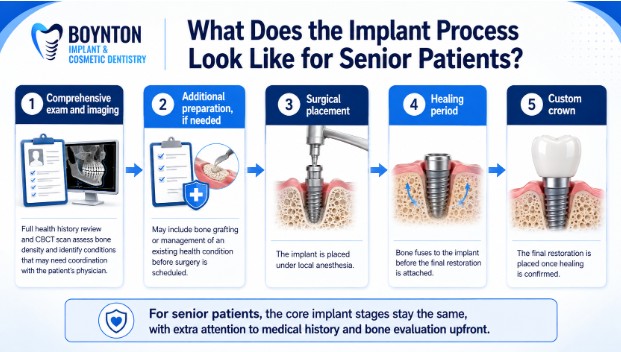
The implant process for senior patients follows the same core stages as for any adult patient, with extra attention paid to health history and bone evaluation upfront:
Some senior patients with adequate remaining bone may be candidates for All-on-4, which uses four implants rather than one per tooth to restore a full arch.
All-on-4 isn’t a universal substitute for bone grafting in cases of significant bone loss — candidacy still depends on the amount and distribution of the remaining bone, as confirmed by CBCT imaging, and some patients with substantial resorption will need grafting regardless of the restoration approach they choose.
Ongoing care guidance for senior patients is also published separately for after treatment.
Boynton Implant and Cosmetic Dentistry currently offers a $2,999 flat-rate special covering implant placement and crown restoration per tooth.
Original Medicare generally doesn’t cover dental implants except in narrow, medically necessary circumstances — seniors weighing Medicare’s actual coverage limits can review the practice’s Medicare guide for specifics. For seniors without applicable coverage, two options reduce out-of-pocket cost:
Is there an age limit for getting dental implants? There is no strict upper age limit for dental implants. Candidacy depends primarily on overall health and jawbone density rather than age alone. Research on patients 65 and older shows survival rates comparable to younger patients, and people in their 80s and 90s receive implants.
How does bone density affect whether a senior can get implants? Bone density determines whether an implant can be placed without extra preparation. When a CBCT scan shows insufficient density — common after years of missing teeth or with osteoporosis — bone grafting can rebuild the site first, adding time but not ruling out treatment.
Are dental implants safe for seniors with osteoporosis? Dental implants can be safe for many patients with osteoporosis when properly planned. Bone density and any bisphosphonate medication history are reviewed beforehand, since certain medications require closer monitoring. A physician may be consulted for coordinated care when needed, particularly before surgery.
Why do implants preserve the jawbone better than dentures? Dental implants replace the tooth root itself, which stimulates the jawbone similarly to a natural tooth. Dentures rest on top of the gums without reaching the bone, so the jawbone beneath a denture continues to shrink over time without that stimulation.
Is a denture ever a better choice than an implant for a senior? Yes, for some patients. Dentures may fit better for those who aren’t good surgical candidates, have health conditions that raise surgical risk, prefer avoiding surgery, or face budget or timeline constraints. A consultation helps determine which option actually fits an individual case.
Does Medicare cover dental implants for seniors? Original Medicare generally doesn’t cover dental implants except in rare, medically necessary cases tied to a covered medical procedure. Some Medicare Advantage plans may offer partial implant coverage, though benefits vary significantly by plan and should be verified individually with each patient’s specific plan.
Can seniors with health conditions like diabetes or heart disease get implants? Many seniors with diabetes, heart disease, or other managed conditions can still receive implants successfully. The practice reviews medical history and coordinates with a patient’s physician when needed; any changes to existing medications are directed by that physician, not adjusted independently.
What if a senior has already lost significant bone from long-term denture wear? Significant bone loss doesn’t automatically rule out implants. Bone grafting is typically the first option evaluated, and full-arch solutions such as All-on-4 may also fit some cases, though candidacy always depends on the bone a CBCT scan actually shows — not a general rule.
Palm Beach County seniors ready to find out whether implants or dentures are right for them can schedule a free consultation with Dr. Berglass — no age cutoff, no pressure, just a straight answer.

About Dr. Berglass
Dr. Michael Berglass, a dedicated dentist with over 25 years of experience, specializes in dental implants, cosmetic, and general dentistry in Boynton Beach, Florida. A proud alumnus of Stony Brook School of Dental Medicine (DDS, 1996), Dr. Berglass further honed his expertise with residencies in general practice and dental implants at North Shore-Long Island Jewish Hospital. His journey in dentistry has taken him from New York to North Carolina, and now to Florida, where he continues to offer top-notch dental care. Known for his wit and intellect, Dr. Berglass makes every patient's visit comfortable. A member of the American Dental Association and Florida Dentists' Association, he stays at the forefront of dental advancements. Dr. Berglass is committed to providing exceptional care and looks forward to welcoming you to his practice.
Reason To Smile

Phone
Address
2415 Quantum Blvd
Boynton Beach, FL 3342
Office Hours
Mon - Thurs: 8:30AM-5PM
Fri: 8:30AM-1PM
Sat - Sun: Closed


